Hauptinhalt

impulseplot

Plot impulse response of dynamic system

    Description

    The impulseplot function plots the impulse response of a dynamic system model. To customize the plot, you can return an ImpulsePlot object and modify it using dot notation. For more information, see Customize Linear Analysis Plots at Command Line.

    To obtain impulse response data or create an impulse plot with default plotting options, use the impulse function.

    impulseplot(sys) plots the impulse response of the dynamic system model sys.

    If sys is a multi-input, multi-output (MIMO) model, then the impulseplot function creates a grid of plots with each plot displaying the impulse response of one input-output pair.

    If sys is a model with complex coefficients, then the plot shows both the real and imaginary components of the response on a single axes and indicates the imaginary component with a diamond marker. You can also view the response using magnitude-phase and complex-plane plots. (since R2025a)

    example

    impulseplot(sys1,sys2,...,sysN) plots the impulse response of multiple dynamic systems sys1,sys2,…,sysN on the same plot.

    example

    impulseplot(sys1,LineSpec1,...,sysN,LineSpecN) sets the line style, marker type, and color for the impulse response of each specified system.

    example

    impulseplot(___,t) simulates the response for the time steps specified by t. You can use t with any of the input argument combinations in previous syntaxes. To define the time steps, you can specify:

    • Final simulation time using a scalar value.

    • The initial and final simulation times using a two-element vector. (since R2023b)

    • All the time steps using a vector.

    example

    impulseplot(sys,t,p) also specifies the parameter trajectory p for LPV models. (since R2023a)

    impulseplot(___,config) specifies additional options for computing the step response, such as the step amplitude (dU) or input offset (U). Use RespConfig to create config.

    impulseplot(___,plotoptions) plots the impulse response with the plotting options specified in plotoptions. Settings you specify in plotoptions override the plotting preferences for the current MATLAB® session. This syntax is useful when you want to write a script to generate multiple plots that look the same regardless of the local preferences.

    impulseplot(___,Name=Value) specifies response properties using one or more name-value arguments. For example, impulseplot(sys,LineWidth=1) sets the plot line width to 1. (since R2026a)

    • When plotting responses for multiple systems, the specified name-value arguments apply to all responses.

    • The following name-value arguments override values specified in other input arguments.

      • TimeSpec — Overrides time values specified using t

      • Config — Overrides options specified using config

      • Parameter — Overrides parameter values specified using p

      • Color — Overrides colors specified using LineSpec

      • MarkerStyle — Overrides marker styles specified using LineSpec

      • LineStyle — Overrides line styles specified using LineSpec

    ip = impulseplot(parent,___) plots the impulse response in the specified parent graphics container, such as a Figure or TiledChartLayout, and sets the Parent property. Use this syntax when you want to create a plot in a specified open figure or when creating apps in App Designer.

    ip = impulseplot(___) plots the impulse response and returns the corresponding chart object. To customize the appearance and behavior of the response plot, modify the chart object properties using dot notation.

    Examples

    collapse all

    Generate a random state-space model with 5 states and create the impulse response plot with chart object ip.

    rng("default")
    sys = rss(5);
    ip = impulseplot(sys);

    MATLAB figure

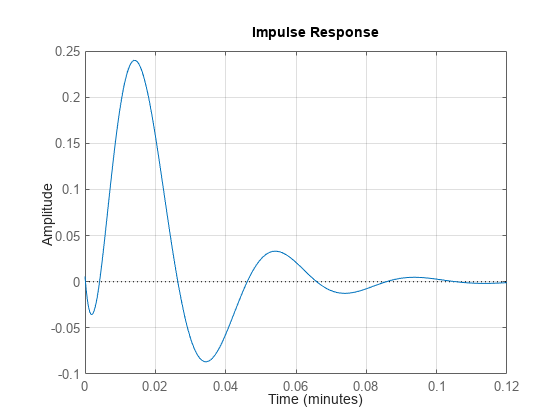
    Change the time units to minutes and turn on the grid.

    ip.TimeUnit = "minutes";
    grid on
    MATLAB figure

    The impulse plot automatically updates when you modify the chart object properties.

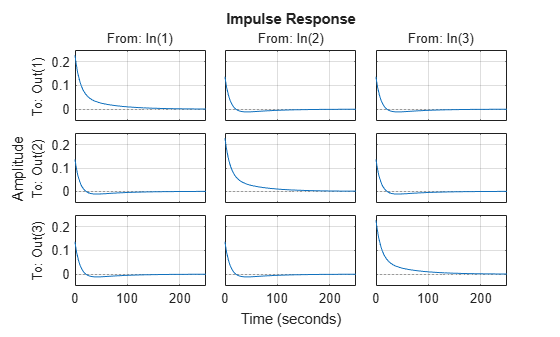
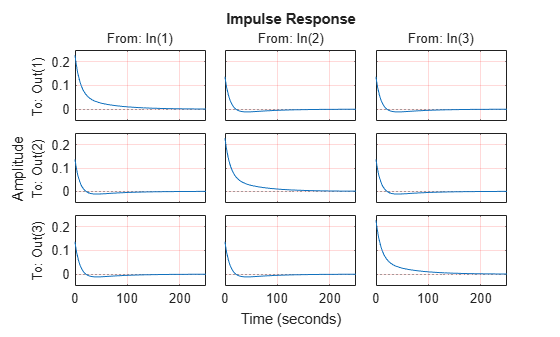
    For this example, consider a MIMO state-space model with 3 inputs, 3 outputs and 3 states. Create an impulse plot with red colored grid lines.

    Create the MIMO state-space model sys_mimo.

    J = [8 -3 -3; -3 8 -3; -3 -3 8];
    F = 0.2*eye(3);
    A = -J\F;
    B = inv(J);
    C = eye(3);
    D = 0;
    sys_mimo = ss(A,B,C,D);
    size(sys_mimo)
    State-space model with 3 outputs, 3 inputs, and 3 states.
    

    Create an impulse plot with chart object ip and display the grid.

    ip = impulseplot(sys_mimo);
    grid on
    MATLAB figure

    Set the grid color to red.

    ip.AxesStyle.GridColor = [1 0 0];
    MATLAB figure

    The impulse plot automatically updates when you modify the chart object. For MIMO models, impulseplot produces a grid of plots, each plot displaying the impulse response of one I/O pair.

    Compare the impulse response of a parametric identified model to a nonparametric (empirical) model, and view their 3-σ confidence regions. (Identified models require System Identification Toolbox™ software.)

    Identify a parametric and a nonparametric model from sample data.

    load iddata1 z1
    sys1 = ssest(z1,4); 
    sys2 = impulseest(z1);

    Plot the impulse responses of both identified models. Use the plot handle to display the 3-σ confidence regions.

    t = -1:0.1:5;
    h = impulseplot(sys1,'r',sys2,'b',t);
    showConfidence(h,3)
    legend('parametric','nonparametric')

    MATLAB figure

    The nonparametric model sys2 shows higher uncertainty.

    For this example, examine the impulse response of the following zero-pole-gain model and limit the impulse plot to tFinal = 15 s. Use 15-point blue text for the title.

    sys = zpk(-1,[-0.2+3j,-0.2-3j],1)*tf([1 1],[1 0.05]);
    tFinal = 15;

    Create the impulse response plot and specify the title size and color.

    ip = impulseplot(sys,tFinal);
    ip.Title.FontSize = 15;
    ip.Title.Color = [0 0 1];

    MATLAB figure

    Since R2025a

    Create a state-space model with complex coefficients.

    A = [-2-2i -2;1 0];
    B = [2;0];
    C = [0 0.5+2.5i];
    D = 0;
    sys = ss(A,B,C,D);

    Plot the impulse response of the system.

    ip = impulseplot(sys);

    MATLAB figure

    By default, the plot shows the real and imaginary components of the response on a single axes, indicating the imaginary component using a diamond marker.

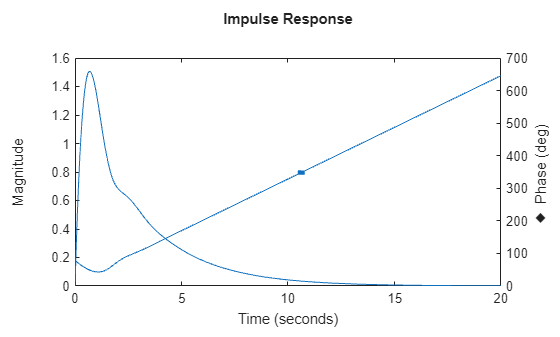
    You can also view the complex response using either a magnitude-phase plot or a complex-plane plot. For example, to view the magnitude and phase of the response, right-click the plot area and select Complex View >Magnitude-Phase.

    ip.ComplexViewType = "magnitudephase";
    MATLAB figure

    The plot shows the magnitude and phase of the response on a single axes, indicating the phase plot using a diamond marker.

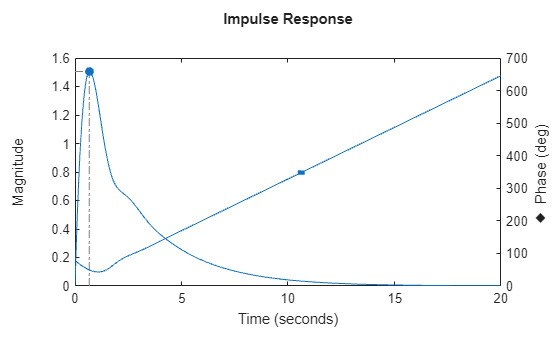
    You can view response characteristics in the plot. For example, to view the peak response, right-click the plot and select Characteristics > Peak Response.

    Alternatively, you can enable the Visible property of the corresponding characteristic parameter of the chart object.

    ip.Characteristics.PeakResponse.Visible = "on";
    MATLAB figure

    Input Arguments

    collapse all

    Dynamic system, specified as a SISO or MIMO dynamic system model or an array of dynamic system models. You can use these types of dynamic systems:

    • Continuous-time or discrete-time numeric LTI models, such as tf, zpk, or ss models.

    • Generalized or uncertain LTI models such as genss or uss models. (Using uncertain models requires Robust Control Toolbox™ software.)

      • For tunable control design blocks, the function evaluates the model at its current value for both plotting and returning response data.

      • For uncertain control design blocks, the function plots the nominal value and random samples of the model. When you use output arguments, the function returns response data for the nominal model only.

    • Sparse state-space models such as sparss and mechss models.

    • Identified LTI models, such as idtf, idss, or idproc models. For such models, the function can also plot confidence intervals and return standard deviations of the frequency response. See Step Responses of Identified Models with Confidence Regions. (Using identified models requires System Identification Toolbox™ software.)

    • Linear time-varying (ltvss) and linear parameter-varying (lpvss) models.

    This function does not support frequency-response data models such as frd, genfrd, or idfrd models.

    If sys is an array of models, the function plots the responses of all models in the array on the same axes. See Step Response of Systems in a Model Array.

    Line style, marker, and color, specified as a string or character vector containing symbols. The symbols can appear in any order. You do not need to specify all three characteristics. For example, specify the marker and omit the line style, then the plot shows only the marker and no line.

    Example: '--or' is a red dashed line with circle markers.

    Line StyleDescription
    "-"Solid line
    "--"Dashed line
    ":"Dotted line
    "-."Dash-dotted line
    MarkerDescription
    "o"Circle
    "+"Plus sign
    "*"Asterisk
    "."Point
    "x"Cross
    "_"Horizontal line
    "|"Vertical line
    "s"Square
    "d"Diamond
    "^"Upward-pointing triangle
    "v"Downward-pointing triangle
    ">"Right-pointing triangle
    "<"Left-pointing triangle
    "p"Pentagram
    "h"Hexagram
    ColorDescription
    "r"red
    "g"green
    "b"blue
    "c"cyan
    "m"magenta
    "y"yellow
    "k"black
    "w"white

    Time steps at which to compute the response, specified as one of these values:

    • Positive scalar tFinal— Compute the response from t = 0 to t = tFinal.

    • Two-element vector [t0 tFinal] — Compute the response from t = t0 to t = tFinal. (since R2023b)

    • Vector Ti:dt:Tf— Compute the response for the time points specified in t.

      • For continuous-time systems, dt is the sample time of a discrete approximation to the continuous system.

      • For discrete-time systems with a specified sample time, dt must match the sample time property Ts of sys.

      • For discrete-time systems with an unspecified sample time (Ts = -1), dt must be 1.

    • [] — Automatically select time values based on system dynamics.

    When you specify a time range using either tFinal or [t0 tFinal]:

    • For continuous-time systems, the function automatically determines the size of the time step and number of points based on the system dynamics.

    • For discrete-time systems with a specified sample time, the function uses the sample time of sys as the step size.

    • For discrete-time systems with unspecified sample time (Ts = -1), the function interprets tFinal as the number of sampling periods to simulate with a sample time of 1 second.

    Express t using the time units specified in the TimeUnit property of sys.

    If you specify a step delay td using config, the function applies the step at t = t0+td.

    Before R2026a: Specify time values using the Responses.SourceData.TimeSpec property.

    LPV model parameter trajectory, specified as a matrix or a function handle.

    • For exogenous or explicit trajectories, specify p as a matrix with dimensions N-by-Np, where N is the number of time samples and Np is the number of parameters.

      Thus, the row vector p(i,:) contains the parameter values at the ith time step.

    • For endogenous or implicit trajectories, specify p as a function handle of the form p = F(t,x,u) in continuous time and p = F(k,x,u) in discrete time that gives parameters as a function of time t or time sample k, state x, and input u.

      This option is useful when you want to simulate quasi-LPV models.

    Configuration of the applied impulse signal, specified as a RespConfig object. By default, impulse applies an input at time t = 0. Use this input argument to change the response configuration, such as specifying a delay or input offset. See Configure Options for Impulse Response for an example.

    For lpvss and ltvss models with offsets (x0(t),u0(t)), you can use RespConfig to define the input relative to u0(t,p) and initialize the simulation with the state x0(t,p).

    Time response plot options, specified as a timeoptions object. You can use these options to customize the plot appearance. Settings you specify in plotoptions override the preference settings for the current MATLAB session.

    Parent graphics container, specified as one of these objects:

    • Figure

    • TiledChartLayout

    • UIFigure

    • UIGridLayout

    • UIPanel

    • UITab

    Name-Value Arguments

    collapse all

    Specify optional pairs of arguments as Name1=Value1,...,NameN=ValueN, where Name is the argument name and Value is the corresponding value. Name-value arguments must appear after other arguments, but the order of the pairs does not matter.

    Example: impulseplot(sys,LegendDisplay="off") hides the response of sys from the plot legend.

    Time steps at which to compute the response, specified as one of these values. Specifying time values using a name-value argument overrides the time values that you specify using t.

    • Positive scalar tFinal— Compute the response from t = 0 to t = tFinal.

    • Two-element vector [t0 tFinal] — Compute the response from t = t0 to t = tFinal.

    • Vector Ti:dt:Tf— Compute the response for the time points specified in t.

      • For continuous-time systems, dt is the sample time of a discrete approximation to the continuous system.

      • For discrete-time systems with a specified sample time, dt must match the sample time property Ts of sys.

      • For discrete-time systems with an unspecified sample time (Ts = -1), dt must be 1.

    • [] — Automatically select time values based on system dynamics.

    When you specify a time range using either tFinal or [t0 tFinal]:

    • For continuous-time systems, the function automatically determines the size of the time step and number of points based on the system dynamics.

    • For discrete-time systems with a specified sample time, the function uses the sample time of sys as the step size.

    • For discrete-time systems with unspecified sample time (Ts = -1), the function interprets tFinal as the number of sampling periods to simulate with a sample time of 1 second.

    Express TimeSpec using the time units specified in the TimeUnit property of sys.

    If you specify a step delay td using config, the function applies the step at t = t0+td.

    Response configuration options, specified as a RespConfig object.

    Specifying response configuration options using a name-value argument overrides the options that you specify using config.

    LPV model parameter trajectory, specified as a matrix or a function handle. Specifying parameter values using a name-value argument overrides the parameter values that you specify using p.

    • For exogenous or explicit trajectories, specify Parameter as a matrix with dimensions N-by-Np, where N is the number of time samples and Np is the number of parameters.

      Thus, the row vector p(i,:) contains the parameter values at the ith time step.

    • For endogenous or implicit trajectories, specify Parameter as a function handle of the form p = F(t,x,u) in continuous time and p = F(k,x,u) in discrete time that gives parameters as a function of time t or time sample k, state x, and input u.

      This option is useful when you want to simulate quasi-LPV models.

    Response name, specified as a string or character vector and stored as a string.

    Response visibility, specified as one of these logical on/off values:

    • "on", 1, or true — Display the response in the plot.

    • "off", 0, or false — Do not display the response in the plot.

    The value is stored as an on/off logical value of type matlab.lang.OnOffSwitchState.

    Option to list the response in the legend, specified as one of these logical on/off values:

    • "on", 1, or true — List the response in the legend.

    • "off", 0, or false — Do not list the response in the legend.

    The value is stored as an on/off logical value of type matlab.lang.OnOffSwitchState.

    Marker style, specified as one of these values. Specifying a marker style using a name-value argument overrides any marker style that you specify using LineSpec.

    MarkerDescription
    "none"No marker
    "o"Circle
    "+"Plus sign
    "*"Asterisk
    "."Point
    "x"Cross
    "_"Horizontal line
    "|"Vertical line
    "s"Square
    "d"Diamond
    "^"Upward-pointing triangle
    "v"Downward-pointing triangle
    ">"Right-pointing triangle
    "<"Left-pointing triangle
    "p"Pentagram
    "h"Hexagram

    Plot color, specified as an RGB triplet or a hexadecimal color code and stored as an RGB triplet. Specifying a color using a name-value argument overrides any color that you specify using LineSpec.

    You can also specify some common colors by name. This table lists these colors and their corresponding RGB triplets and hexadecimal color codes.

    Color NameRGB TripletHexadecimal Color Code

    "red" or "r"

    [1 0 0]#FF0000

    "green" or "g"

    [0 1 0]#00FF00

    "blue" or "b"

    [0 0 1]#0000FF

    "cyan" or "c"

    [0 1 1]#00FFFF

    "magenta" or "m"

    [1 0 1]#FF00FF

    "yellow" or "y"

    [1 1 0]#FFFF00

    "black" or "k"

    [0 0 0]#000000

    "white" or "w"

    [1 1 1]#FFFFFF

    Line style, specified as one of these values. Specifying a line style using a name-value argument overrides any line style that you specify using LineSpec.

    Line StyleDescription
    "-"Solid line
    "--"Dashed line
    ":"Dotted line
    "-."Dash-dotted line
    "none"No line

    Marker size, specified as a positive scalar.

    Line width, specified as a positive scalar.

    Series index, specified as a positive integer or "none".

    By default, the SeriesIndex property is a number that corresponds to the order in which the response was added to the chart, starting at 1. MATLAB uses the number to calculate indices for automatically assigning color, line style, or markers for responses. Any responses in the chart that have the same SeriesIndex number also have the same color, line style, and markers.

    A SeriesIndex value of "none" indicates that a response does not participate in the indexing scheme.

    Output Arguments

    collapse all

    Chart object, returned as a ImpulsePlot object. To customize your plot appearance and behavior, modify the properties of this object using dot notation. For more information, see ImpulsePlot Properties.

    Version History

    Introduced before R2006a

    expand all