Image Transforms
R2026bAn image transform converts an image from one domain to another. Images are usually acquired and displayed in the spatial domain, in which adjacent pixels represent adjacent parts of the scene. However, images can also be acquired in other domains, such as the frequency domain in which adjacent pixels represent adjacent frequency components, or the Hough domain in which adjacent pixels represent adjacent projection angles and radial distances. Viewing and processing an image in nonspatial domains can enable the identification of features that are less easily detected in the spatial domain.
Functions
hough | Hough transform |
houghlines | Extract line segments based on Hough transform |
houghpeaks | Identify peaks in Hough transform |
radon | Radon transform |
iradon | Inverse Radon transform |
fanbeam | Fan-beam transform |
ifanbeam | Inverse fan-beam transform |
fan2para | Convert fan-beam projections to parallel-beam |
para2fan | Convert parallel-beam projections to fan-beam |
fft2 | 2-D fast Fourier transform |
fftshift | Shift zero-frequency component to center of spectrum |
ifft2 | 2-D inverse fast Fourier transform |
ifftshift | Inverse zero-frequency shift |
dct2 | 2-D discrete cosine transform |
idct2 | 2-D inverse discrete cosine transform |
dctmtx | Discrete cosine transform matrix |
Topics
- Fast Fourier Transform
Learn about the Fourier transform and some of its applications in image processing, particularly in image filtering.
- Discrete Cosine Transform
Learn about the discrete cosine transform (DCT) of an image and its applications, particularly in image compression.
- Hough Transform
The Hough transform detects lines in a binary image, including lines tilted at arbitrary angles from vertical and horizontal.
- Radon Transform
The Radon transform calculates parallel-beam projections of a grayscale image at different rotation angles, typically for use in tomographic reconstruction.
- The Inverse Radon Transformation
The inverse Radon transform reconstructs an image from a set of parallel-beam projection data across many projection angles.
- Fan-Beam Projection
Use fan-beam projection and reconstruction when projections of an image are acquired along paths radiating from a point source. Medical tomography is a common application of fan-beam projection.
- Principal Component Analysis of Images
Principal component analysis (PCA) is a statistical technique used to reduce the number of variables per sample, also known as the dimensionality, of large data sets while preserving as much important information as possible. (Since R2026a)
Featured Examples
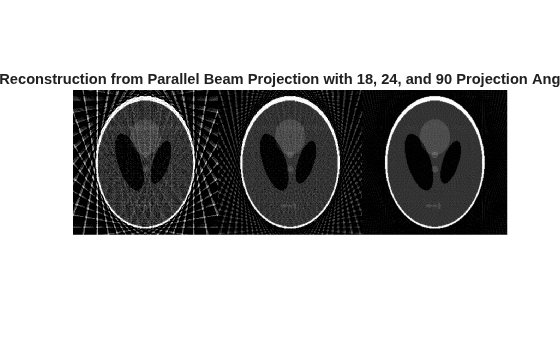
Reconstructing an Image from Projection Data
Form parallel-beam and fan-beam projections from a head phantom image, and reconstruct the image using radon and fan-beam transforms.
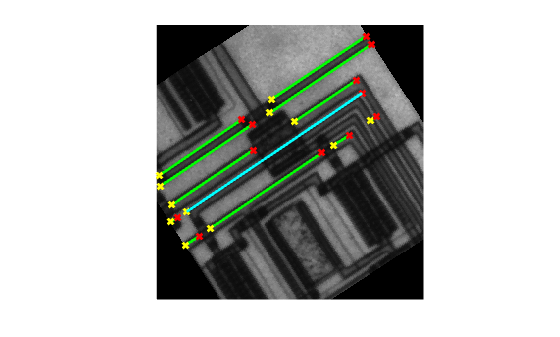
Detect Lines and Highlight Longest Segment Using Hough Transform
Detect lines in an image using the Hough transform.
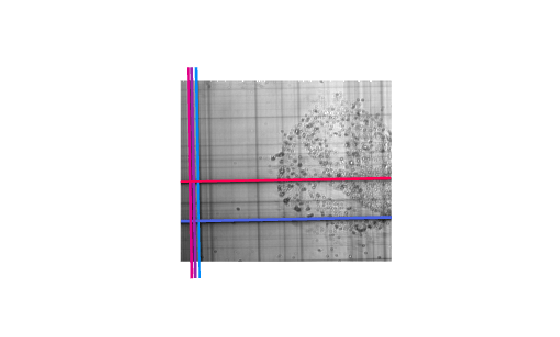
Detect Lines Using Radon Transform
Detect lines and identify the strongest lines in an image using the Radon transform.
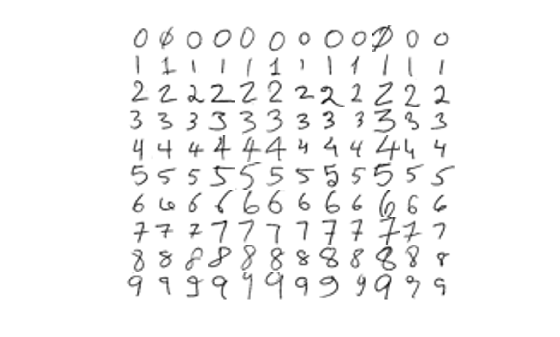
Identify Digits Using PCA for Feature Extraction
Identify digits from a data set of handwritten digits using principal component analysis (PCA) for feature extraction.

Locate Template in Image Using FFT-Based Correlation
Locate instances of a template in an image by using the Fast Fourier Transform and template matching.

