getrom
R2026bDescription
Examples
This example shows how to obtain a reduced-order model of a structural beam using the zero-pole truncation method. For this example, consider a SISO sparse state-space model of a cantilever beam. This example uses the linearized model from the Linear Analysis of Cantilever Beam example.
Load the beam model.
load linBeam.mat
size(sys)
Sparse second-order model with 1 outputs, 1 inputs, and 3303 degrees of freedom.
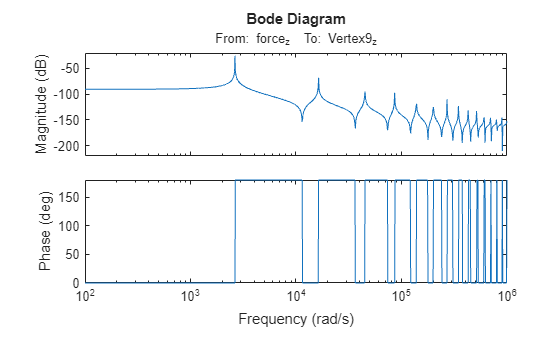
Analyze the frequency response of the model.
bodeplot(sys,w)
To perform sparse zero-pole truncation, first create a model order reduction task using reducespec with the "zpk" method.
R = reducespec(sys,"zpk");For this task, set the frequency range of focus to compute modes up to 3e5 rad/s. Doing so prevents the algorithm from computing all the poles and zeros of the sparse model, which can take a long time in some cases.
R.Options.Focus = [0 3e5];
R.Options.Display = "off";
Run the model reduction algorithm. This computes the derived information, which are the poles, zeros, and gains of model, stored in the object R.
R = process(R);
You can visualize the map of computed poles and zeros using the view function.
view(R)
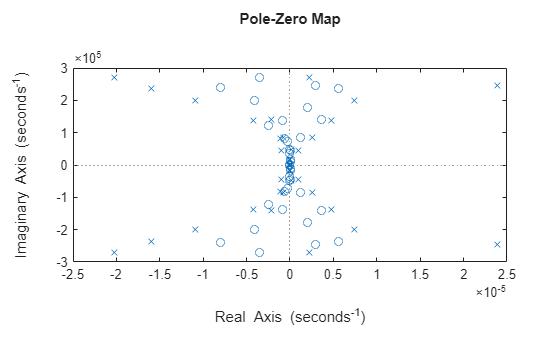
Obtain the reduced zero-pole-gain approximation based on the specified frequency of focus.
rsys = getrom(R);
order(rsys)
ans =
38
Compare the response of the original and reduced models.
figure;
opt = bodeoptions;
opt.PhaseWrapping = "on";
bodeplot(sys,rsys,"--",w,opt);
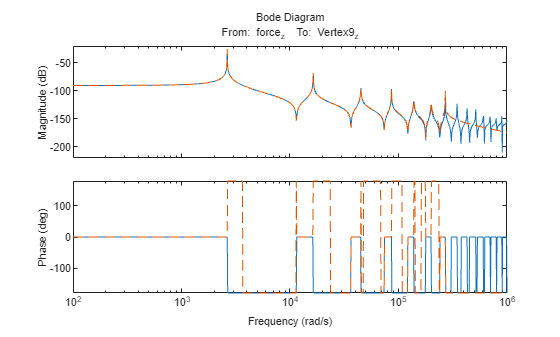
The reduced-order model provides a good approximation for the original sparse model in the specified range of interest.
This example shows how to obtain a reduced model using zero-pole truncation of a sparse state-space model. This example uses a sparse model obtained from linearizing a thermal model of heat distribution in a circular cylindrical rod.
Load the model data.
load cylindricalRod.mat
sys = sparss(A,B,C,D,E);
w = logspace(-7,-1,20);
size(sys)
Sparse state-space model with 3 outputs, 1 inputs, and 7522 states.
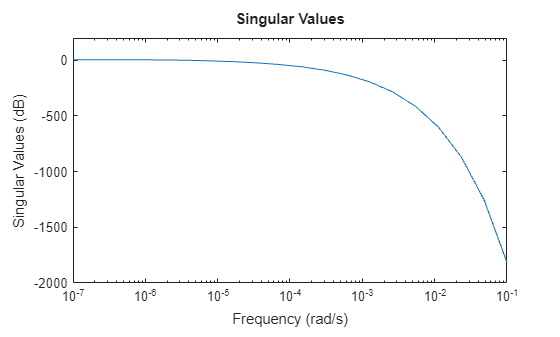
Analyze the frequency response of the model.
sigmaplot(sys,w)
Create a zero-pole truncation specification object for sys and specify the frequency band of focus. For this model, you can use a frequency range from 0 rad/s to 0.01 rad/s to obtain the low-order approximation.
R = reducespec(sys,"zpk");
R.Options.Focus = [0 1e-2];
R.Options.Display = "off";
Run the model reduction algorithm and obtain the reduced model.
R = process(R);
rsys = getrom(R);
sigmaplot(sys,rsys,w)
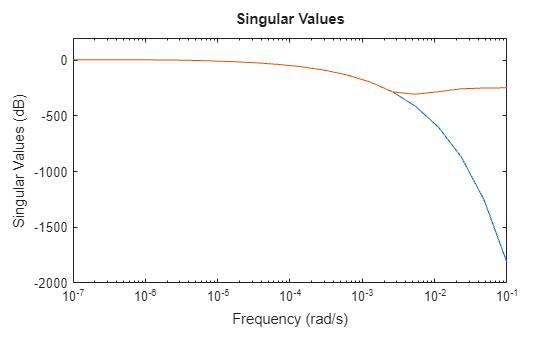
This thermal model has a very steep roll-off beyond 0.001 rad/s. By default, the reduced model obtained using getrom does not provide a good match for this roll-off. To mitigate this, you can use the RollOff argument of getrom and specify a minimum roll-off value beyond the frequency band of focus. Specify a roll-off slope value of -45, which corresponds to a rate of at least –900 db/decade.
rsys2 = getrom(R,RollOff=-45);
sigmaplot(sys,rsys2,w)
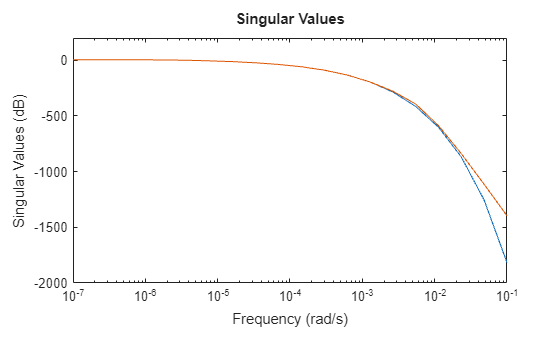
The reduced model now provides a much better approximation of the roll-off value.
Input Arguments
Output Arguments
Extended Capabilities
Version History
Introduced in R2025a

