Hauptinhalt

height2grndrange

Convert target height to ground range

Since R2021b

Description

gr = height2grndrange(tgtht,anht,el) returns the ground range to the target, gr, as a function of the target height tgtht, the sensor height anht, and the elevation angle of the sensor el, assuming a Curved Earth Model with a 4/3 effective Earth radius factor.

example

gr = height2grndrange(tgtht,anht,el,Name=Value) specifies additional inputs using name-value arguments. For example, you can specify a flat Earth model, a curved Earth model with a given radius, or a CRPL Exponential Reference Atmosphere Model with custom values.

example

Examples

collapse all

Compute the range along the propagated path for a target height of 1 km, an antenna height of 10 meters, and an elevation angle of 2 degrees at the radar. Assume a curved Earth model with a 4/3 effective Earth radius.

r = height2grndrange(1e3,10,2)
r = 
2.7106e+04

Compute the range along the propagated path using the CRPL exponential reference atmosphere. Assume a target height of 1 km, an antenna height of 10 meters, and an elevation angle of 2 degrees at the radar.

gr = height2grndrange(1e3,10,2,Method="CRPL")
gr = 
2.7143e+04

Input Arguments

collapse all

Target height specified as a nonnegative scalar or length-M row vector. If tgtht is a vector, it must have the same size as the other vector input arguments of height2grndrange. Heights are referenced to the ground. Units are in meters.

Data Types: double

Sensor height specified as a nonnegative scalar or length-M row vector. If anht is a vector, it must have the same size as the other vector input arguments of height2grndrange. Heights are referenced to the ground. Units are in meters.

Data Types: double

Elevation angle of the sensor, specified as scalar or length-M row vector. The elevation angle is the initial elevation angle of the ray leaving the sensor. If el is a vector, it must have the same size as the other vector input arguments of height2grndrange. Units are in degrees.

Data Types: double

Name-Value Arguments

collapse all

Specify optional pairs of arguments as Name1=Value1,...,NameN=ValueN, where Name is the argument name and Value is the corresponding value. Name-value arguments must appear after other arguments, but the order of the pairs does not matter.

Example: height2grndrange = (tgtht,anht,el,Method="CRPL",SurfaceRefractivity=300,RefractionExponent=0.15)

Earth model used for the computation, specified as "Curved", "Flat", or "CRPL".

  • "Curved" — Assumes a Curved Earth Model with an effective radius of 4/3 times the actual Earth radius, which is a commonly used approximation for modeling refraction effects in the troposphere. To specify another value for the effective Earth radius, use the EffectiveEarthRadius name-value pair argument.

  • "Flat" — Assumes a Flat Earth Model. In this case, the effective Earth radius is infinite.

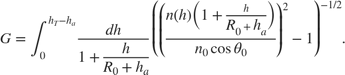
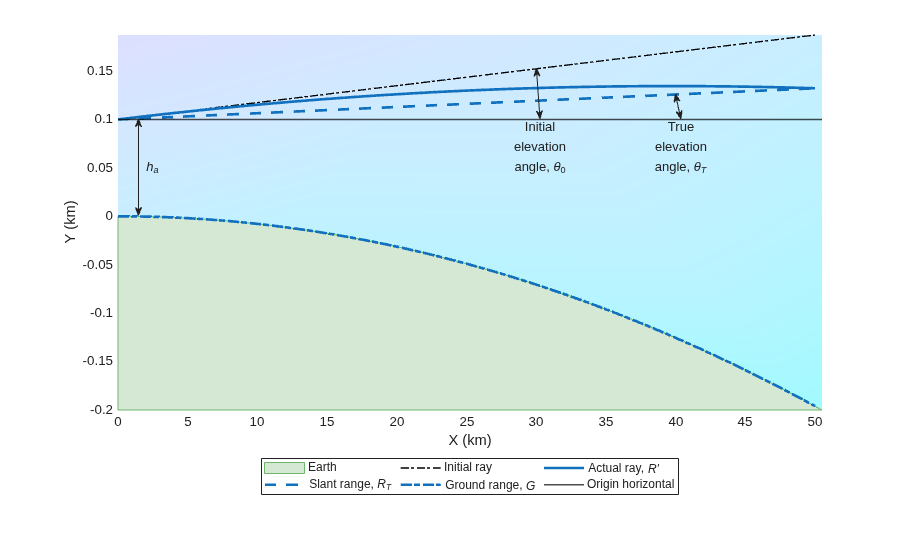
  • "CRPL" — Assumes a curved Earth model with the atmosphere defined by the CRPL Exponential Reference Atmosphere Model with a refractivity of 313 N-units and a refraction exponent of 0.143859 km–1. To specify other values for the refractivity and the refraction exponent, use the SurfaceRefractivity and RefractionExponent name-value arguments. This CRPL Exponential model accounts for refraction at elevation angles greater than approximately 10 millirad (about 0.573 degrees) and heights above approximately 1 km. For more information, see CRPL Model Geometry.

Data Types: char | string

Effective Earth radius in meters, specified as a positive scalar. If this argument is not specified, height2grndrange calculates the effective Earth radius using a refractivity gradient of –39 × 10–9 N-units/meter, which results in approximately 4/3 of the real Earth radius. This argument applies only if Method is specified as "Curved".

Data Types: double

Surface refractivity in N-units, specified as a nonnegative real-valued scalar. The surface refractivity is a parameter of the CRPL Exponential Reference Atmosphere Model used by height2grndrange. This argument applies only if Method is specified as "CRPL".

Data Types: double

Refraction exponent, specified as a nonnegative real-valued scalar. The refraction exponent is a parameter of the CRPL Exponential Reference Atmosphere Model used by height2grndrange. This argument applies only if Method is specified as "CRPL".

Data Types: double

Output Arguments

collapse all

Ground range to target, returned as a scalar or length-M row vector. Units are in meters.

More About

collapse all

References

[1] Barton, David K. Radar Equations for Modern Radar. Norwood, MA: Artech House, 2013.

[2] Bean, B.R., and G.D. Thayer. "Central Radio Propagation Laboratory Exponential Reference Atmosphere." Journal of Research of the National Bureau of Standards, Section D: Radio Propagation 63D, no. 3 (November 1959): 315. https://doi.org/10.6028/jres.063D.031.

[3] Blake, Lamont V. "Ray Height Computation for a Continuous Nonlinear Atmospheric Refractive-Index Profile." Radio Science 3, no. 1 (January 1968): 85–92. https://doi.org/10.1002/rds19683185.

[4] Doerry, A. W. "Earth Curvature and Atmospheric Refraction Effects on Radar Signal Propagation." Sandia National Laboratories, SAND2012-10690 (Jan. 2013).

Extended Capabilities

expand all

C/C++ Code Generation
Generate C and C++ code using MATLAB® Coder™.

Version History

Introduced in R2021b