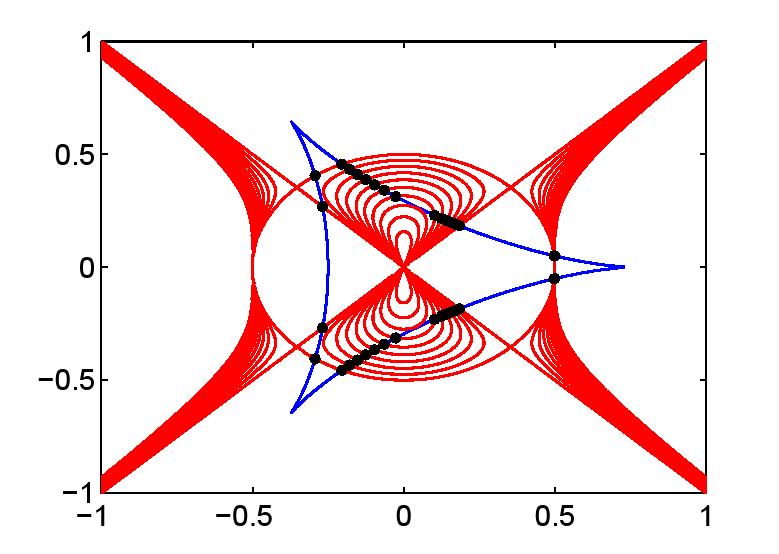
Computing common zeros of two bivariate functions
For bivariate functions f(x,y) and g(x,y), compute values of (x,y) such that f(x,y)=g(x,y)=0

Sie verfolgen jetzt diese Einreichung
- Aktualisierungen können Sie in Ihrem Feed verfolgter Inhalte sehen.
- Je nach Ihren Kommunikationseinstellungen können Sie auch E-Mails erhalten.
Zitieren als
Yuji Nakatsukasa (2026). Computing common zeros of two bivariate functions (https://de.mathworks.com/matlabcentral/fileexchange/44084-computing-common-zeros-of-two-bivariate-functions), MATLAB Central File Exchange. Abgerufen .
Allgemeine Informationen
- Version (14,7 KB)
Kompatibilität der MATLAB-Version
- Kompatibel mit allen Versionen
Plattform-Kompatibilität
- Windows
- macOS
- Linux
| Version | Veröffentlicht | Versionshinweise | Action |
|---|---|---|---|
| 1.0.0 |

