Vehicle Body 6DOF
R2026bTwo-axle vehicle body with translational and rotational motion
Vehicle Body 6DOF block
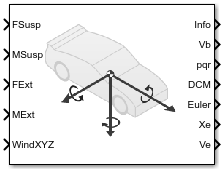
To add a block to a model, double-click the canvas and start typing the block name. Then, select the block from the list.
Libraries:
Vehicle Dynamics Blockset /
Vehicle Body
Description
The Vehicle Body 6DOF block implements a six degrees-of-freedom (DOF) rigid two-axle vehicle body model to calculate longitudinal, lateral, vertical, pitch, roll, and yaw motion. The block accounts for body dimensions, mass, inertia, aerodynamics, road incline and external forces and moments.
This block uses the Vehicle Dynamics Blockset™ Vehicle Coordinate System. The vehicle coordinate system axes (XV, YV, ZV) are fixed in a reference frame attached to the vehicle. The coordinate system conforms to SAE J670 standard with X-forward, Y-right, Z-down orientation with origin at the center of gravity of the sprung mass. Sign convention for steer angle is positive right.
Use the Inertial Loads parameters to analyze the vehicle dynamics under different loading conditions.
You can connect the block to virtual sensors, suspension system, or external systems like body control actuators. Use the Vehicle Body 6DOF block in ride and handling studies to model the effects of aerodynamics, passenger loading and suspension forces and moments.
To create additional input ports, under Input signals, select these block parameters.
Parameter | Input Port | Description |
|---|---|---|
| Rear hitch forces | Fh | Hitch force applied to the body at the rear hitch location, Fhx, Fhy, and Fhz, in the vehicle-fixed frame |
| Rear hitch moments | Mh | Hitch moment at the rear hitch location, Mhx, Mhy, and Mhz, about the vehicle-fixed frame |
Inertial Loads
To analyze the vehicle dynamics under different loading conditions, use the Inertial Loads parameters. Specifically, you can specify these loads:
Front powertrain
Front and rear row passengers
Overhead cargo
Rear cargo
For each of the loads, you can specify the mass, location, and inertia.
The illustrations provide the load locations and vehicle parameter dimensions. The table provides the corresponding location parameter sign settings.
This table summarizes the parameter settings that specify the load locations indicated by the dots. For the location, the block uses this distance vector:
Front suspension hardpoint to load, along the vehicle-fixed x-axis
Vehicle centerline to load, along the vehicle-fixed y-axis
Front suspension hardpoint to load, along the vehicle-fixed z-axis
Load | Parameter | Example Location |
|---|---|---|
Front | Distance vector from front axle, z1R |
|
Overhead | Distance vector from front axle, z2R |
|
Row 1, left side | Distance vector from front axle, z3R |
|
Row 1, right side | Distance vector from front axle, z4R |
|
Row 2, left side | Distance vector from front axle, z5R |
|
Row 2, right side | Distance vector from front axle, z6R |
|
Rear | Distance vector from front axle, z7R |
|
Equations of Motion
To determine the vehicle motion, the block solves the rigid body dynamics equations of motion.
The Vehicle Body 6DOF block considers the rotation of a vehicle-fixed coordinate frame about a flat earth-fixed inertial reference frame. The origin of the vehicle-fixed coordinate frame is the sprung mass center of gravity.
The block uses this equation to calculate the translational motion of the vehicle-fixed coordinate frame, where the applied forces [Fx Fy Fz]T are in the vehicle-fixed frame, and the mass of the body, m, is assumed constant.
To determine the relationship between the vehicle-fixed angular velocity vector, [p q r]T, and the rate of change of the Euler angles, , the block resolves the Euler rates into the vehicle-fixed frame.
Inverting J gives the required relationship to determine the Euler rate vector.
The applied forces and moments are the sum of the aerodynamic, gravitational, external, and suspension forces.
| Calculation | Implementation |
|---|---|
Load masses and inertias | Block uses parallel axis theorem to resolve the individual load masses and inertias with the vehicle mass and inertia. |
Gravitational forces, Fg | Block uses direction cosine matrix (DCM) to transform the gravitational vector in the inertial-fixed frame to the vehicle-fixed frame. |
Aerodynamic forces, Fa, and moments, Ma | To determine a relative airspeed, the block subtracts the wind velocity from the vehicle CG velocity. Using the relative airspeed, the block determines the aerodynamic forces. The signs for the aerodynamic terms indicate a resistive force with respect to the components of the relative wind speed. In this convention, a positive lift coefficient increases downforce (pushing the vehicle to the ground) while a negative lift coefficient generates lift (raising the vehicle upwards). Using the relative airspeed, the block determines the aerodynamic moments. |
External forces, Fin, and moments, Min | External forces and moments are input via ports FExt and MExt. |
Suspension forces and moments | Block assumes that the suspension forces and moments act on these hardpoint locations:
|
The equations use these variables.
Vehicle CG displacement, velocity, and acceleration along the vehicle-fixed x-axis | |
Vehicle CG displacement, velocity, and acceleration along the vehicle-fixed y-axis | |
Vehicle CG displacement, velocity, and acceleration along the vehicle-fixed z-axis | |
φ | Rotation of the vehicle-fixed frame about the earth-fixed X-axis (roll) |
θ | Rotation of the vehicle-fixed frame about the earth-fixed Y-axis (pitch) |
ψ | Rotation of the vehicle-fixed frame about the earth-fixed Z-axis (yaw) |
| FFLx, FFLy, FFLz | Suspension forces applied to front left hardpoint along the vehicle-fixed x-, y-, and z-axes |
| FFRx, FFRy, FFRz | Suspension forces applied to front right hardpoint along the vehicle-fixed x-, y-, and z-axes |
| FRLx, FRLy, FRLz | Suspension forces applied to rear left hardpoint along the vehicle-fixed x-, y-, and z-axes |
| FRRx, FRRy, FRRz | Suspension forces applied to rear right hardpoint along the vehicle-fixed x-, y-, and z-axes |
| MFx, FFy, FFz | Suspension moments applied to vehicle CG about the vehicle-fixed x-, y-, and z-axes |
| Fextx, Fexty, Fextz | External forces applied to vehicle CG along the vehicle-fixed x-, y-, and z-axes |
| Fax, Fay, Faz | Aerodynamic forces applied to vehicle CG along the vehicle-fixed x-, y-, and z-axes |
| Mextx, Mexty, Mextz | External moments applied to vehicle CG about the vehicle-fixed x-, y-, and z-axes |
| Max, May, Maz | Aerodynamic moments applied to vehicle CG about the vehicle-fixed x-, y-, and z-axes |
| I | Sprung mass moments of inertia |
| a, b | Distance of front and rear wheels, respectively, from the normal projection point of vehicle CG onto the common axle plane |
| d | Lateral distance from the geometric centerline to the center of mass along the vehicle-fixed y-axis |
| h | Height of vehicle CG above the axle plane |
| hh | Height of the hitch above the axle plane along the vehicle-fixed z-axis |
| dh | Longitudinal distance of the hitch from the normal projection point of tractor CG onto the common axle plane |
| hl | Lateral distance from center of mass to hitch along the vehicle-fixed y-axis. |
| wF, wR | Front and rear track widths |
| Cd | Aerodynamic drag coefficient acting along vehicle-fixed x-axis |
| Cs | Aerodynamic side coefficient acting along vehicle-fixed y-axis |
| Cl | Aerodynamic lift coefficient acting along vehicle-fixed z-axis |
| Crm | Aerodynamic roll coefficient acting about vehicle-fixed x-axis |
| Cpm | Aerodynamic pitch coefficient acting about the vehicle-fixed y-axis |
| Cym | Aerodynamic yaw coefficient acting about vehicle-fixed z-axis |
| Af | Frontal area |
| R | Atmospheric specific gas constant |
| T | Environmental air temperature |
| Pabs | Environmental absolute pressure |
| wx, wy, wz | Wind velocity along the vehicle-fixed x-, y-, and z-axes |
| Wx, Wy, Wz | Wind velocity along inertial X-, Y-, and Z-axes |
Examples
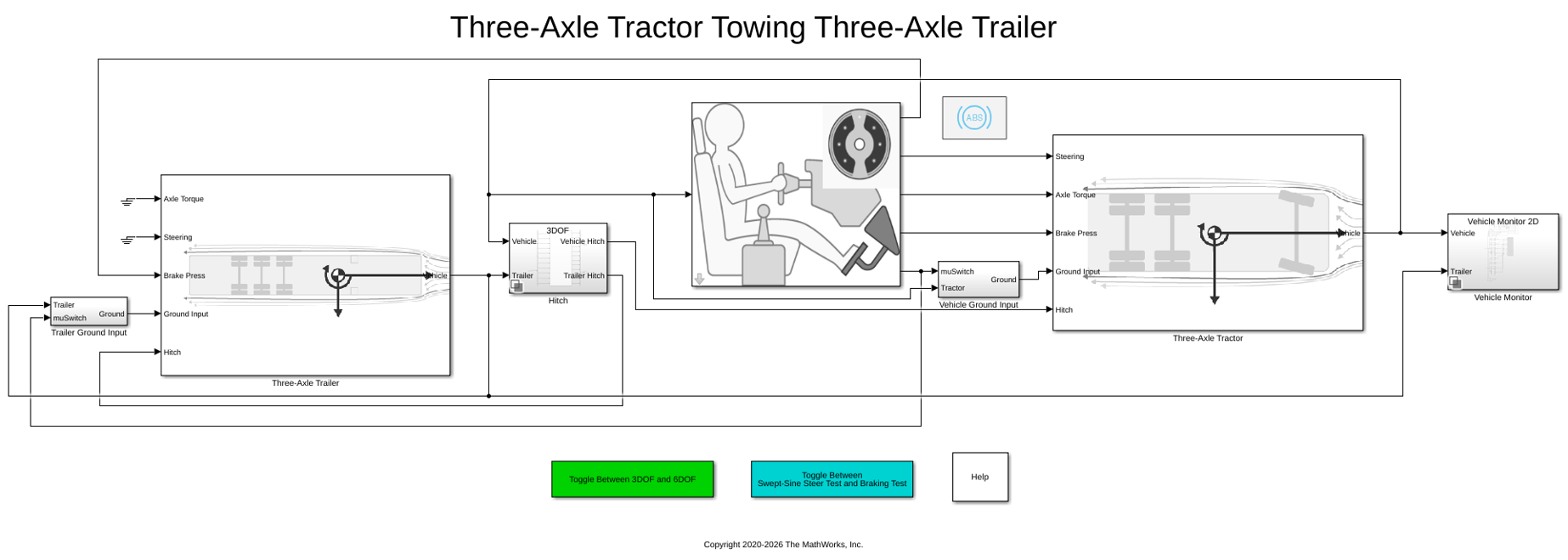
Three-Axle Tractor Towing a Three-Axle Trailer
Simulates three-axle tractor towing a three-axle trailer for commercial trucking applications. Implements hitch subsystem, sinusoidal wave steering or braking test, and axle torque applied to tractor rear wheels.
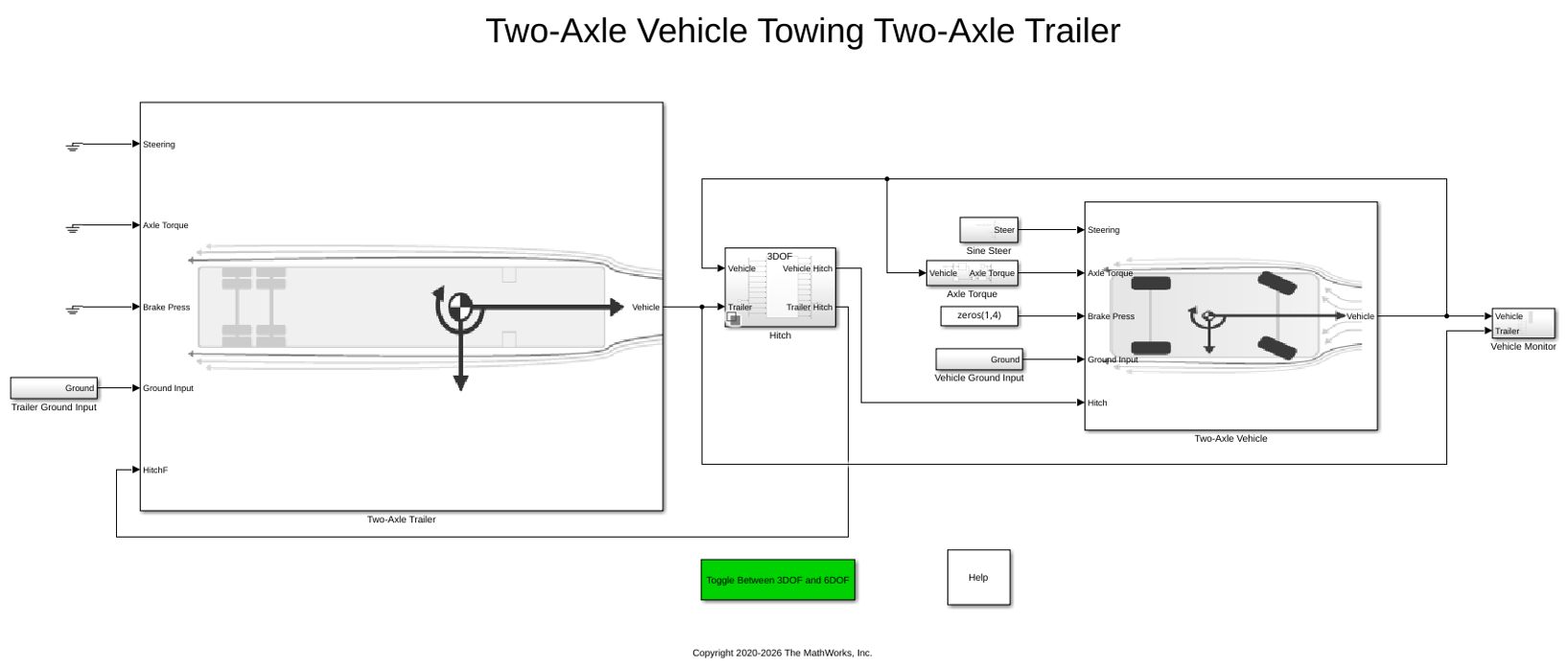
Two-Axle Tractor Towing a Two-Axle Trailer
Simulate a two-axle tractor towing a two-axle trailer for a commercial trucking application. Model implements a hitch subsystem, sinusoidal wave steering input, and an axle torque applied to the rear wheels of the tractor.
Ports
Input
Output
Parameters
References
[1] Gillespie, Thomas. Fundamentals of Vehicle Dynamics. Warrendale, PA: Society of Automotive Engineers (SAE), 1992.
Extended Capabilities
Version History
Introduced in R2018a
See Also
6DOF (Euler Angles) (Aerospace Blockset) | Vehicle Body 3DOF | Vector Concatenate

