Hauptinhalt

Anwendungen

Anwenden von Statistik und Machine-Learning-Methoden auf branchenspezifische Workflows

Statistics and Machine Learning Toolbox™ bietet Tools zur Beschreibung, Analyse und Modellierung von Daten, die unter Leitfaden zum Einstieg in Statistics and Machine Learning Toolbox und Machine Learning in MATLAB beschrieben sind. Sie können diese Tools in Kombination mit anderen MATLAB® Toolboxes für branchenspezifische Workflows verwenden. Einige der Anwendungsbereiche umfassen:

  • Luft- und Raumfahrt – Erkunden Sie Radar und andere Signale, erkennen Sie Anomalien und erstellen Sie prädiktive Modelle.

  • Biotechnologie und Pharmazeutik – Analysieren Sie klinische Daten und führen Sie Modellierungen und Simulationen für die Wirkstoffforschung und -Entwicklung aus.

  • Kommunikation und Signalverarbeitung – Klassifizieren Sie Audio und andere Signale und modellieren Sie drahtlose Geräte und integrierte Schaltkreise.

  • Energieerzeugung – Prognostizieren Sie den Energiebedarf, überwachen Sie Produktionsanlagen und optimieren Sie die Verarbeitung von Chemikalien in Öl und Gas.

  • Industrieautomatisierung und Maschinen – Wenden Sie multivariate Statistik und prädiktive Modellierung auf industrielle Prozessdaten an, überwachen Sie Fertigungsprozesse und Produktqualität und verbessern Sie Auslastung und Ausbeute.

  • Medizinprodukte – Entwickeln Sie auswertbare Machine-Learning-Algorithmen für biomedizinische Zeitreihen und Bilddaten zur Anwendungsentwicklung unter Berücksichtigung der aufsichtsbehördlichen Anforderungen.

  • Quantitatives Finanz- und Risikomanagement – Trainieren, vergleichen und optimieren Sie Modelle für algorithmisches Trading, Kapitalverteilung, Kreditrisiko und Betrugserkennung.

Luft- und Raumfahrt

Radar Target Classification Using Machine Learning and Deep Learning (Radar Toolbox)

Classify radar returns using machine and deep learning approaches.

Biotechnologie und Pharmazeutik

Sequenzierung mit hohem Durchsatz

Wirkstoffforschung und quantitative Pharmakologie

Kommunikation und Signalverarbeitung

Data Analysis on S-Parameters of RF Data Files (RF Toolbox)

Perform statistical analysis on S-parameter data files using magnitude, mean, and standard deviation.

Wavelet Time Scattering with GPU Acceleration — Spoken Digit Recognition (Wavelet Toolbox)

Extract features on your GPU for signal classification.

Feature Selection for Audio Classification (Audio Toolbox)

Perform audio feature selection to select a feature set for either speaker recognition or word recognition tasks.

Speaker Identification Using Pitch and MFCC (Audio Toolbox)

Use machine learning to identify people based on features extracted from recorded speech.

Speaker Diarization Using x-vectors (Audio Toolbox)

Speaker diarization is the process of partitioning an audio signal into segments according to speaker identity.

Accelerate Audio Machine Learning Workflows Using a GPU (Audio Toolbox)

This example shows how to use GPU computing to accelerate machine learning workflows for audio, speech, and acoustic applications. (Seit R2024a)

Generate Synthetic Signals Using Conditional GAN (Signal Processing Toolbox)

Use a conditional generative adversarial network to produce synthetic signals.

Human Activity Recognition Using Signal Feature Extraction and Machine Learning (Signal Processing Toolbox)

Extract features from smartphone sensor signals and use them to classify human activity. (Seit R2021b)

Energieerzeugung

Prädiktive Analytik für das Anlagenmanagement

  • Wind Turbine High-Speed Bearing Prognosis (Predictive Maintenance Toolbox)
    Build an exponential degradation model to predict the Remaining Useful Life (RUL) of a wind turbine bearing in real time. The exponential degradation model predicts the RUL based on its parameter priors and the latest measurements.

Energiehandel und Risikomanagement (ETRM)

Industrieautomatisierung und Maschinen

Fault Detection Using Data Based Models (Predictive Maintenance Toolbox)

Use a data-based modeling approach for fault detection.

Detect Anomalies in Industrial Machinery Using Three-Axis Vibration Data (Predictive Maintenance Toolbox)

Detect anomalies in industrial machine vibration data using machine-learning and deep-learning models trained with data representing only nominal behavior.

Build Condition Model for Industrial Machinery and Manufacturing Processes

Train a binary classification model using Classification Learner App to detect anomalies in sensor data collected from an industrial manufacturing machine.

Rolling Element Bearing Fault Diagnosis (Predictive Maintenance Toolbox)

Perform fault diagnosis of a rolling element bearing based on acceleration signals.

Fault Diagnosis of Centrifugal Pumps Using Residual Analysis (Predictive Maintenance Toolbox)

Use a model parity-equations-based approach for detection and diagnosis of faults in a pumping system.

Air Compressor Fault Detection Using Wavelet Scattering (Wavelet Toolbox)

Classify faults in acoustic recordings of air compressors using a wavelet scattering network and a support vector machine. (Seit R2021b)

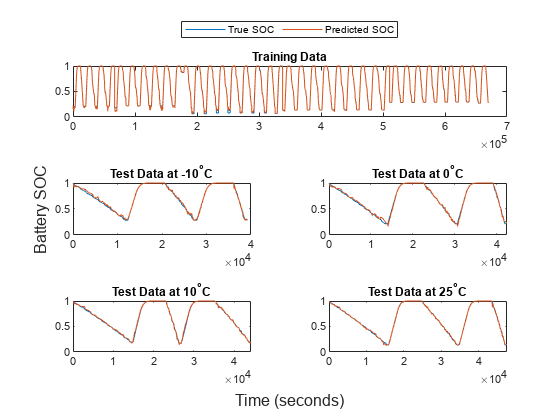
Predict Battery State of Charge Using Machine Learning

Train a Gaussian process regression model to predict the state of charge of a battery in automotive engineering.
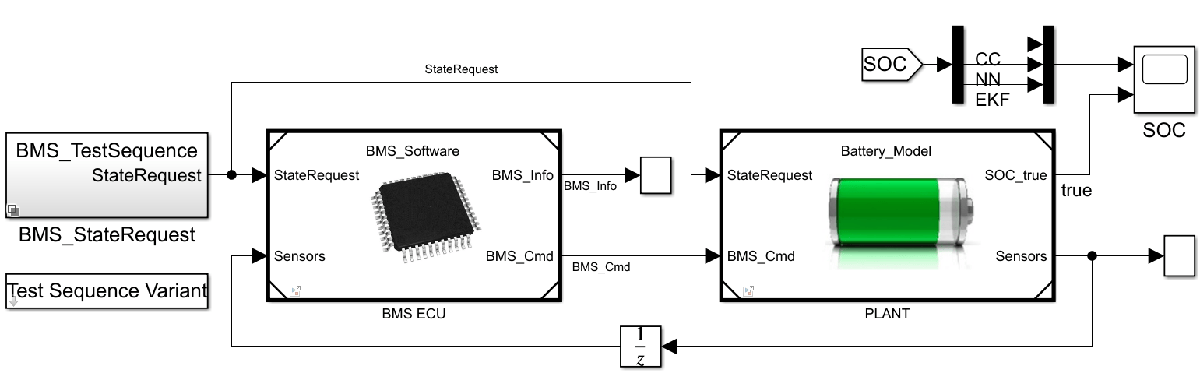
Deploy Neural Network Regression Model to FPGA/ASIC Platform

Predict in Simulink® using a neural network regression model, and deploy the Simulink model to an FPGA/ASIC platform by using HDL code generation.
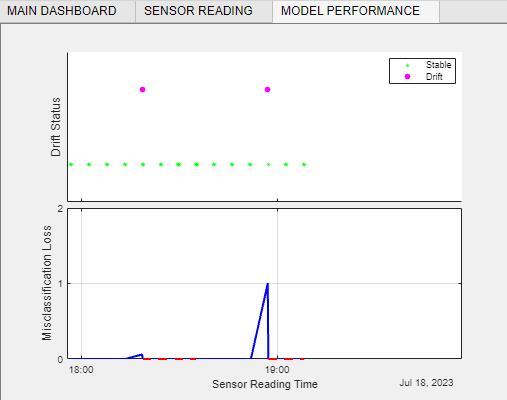
Monitor Equipment State of Health Using Drift-Aware Learning

This example shows how to automate the process of monitoring the state of health for a cooling system using an incremental drift-aware learning model and Streaming Data Framework for MATLAB® Production Server™.

Monitor Equipment State of Health Using Drift-Aware Learning on the Cloud

This example describes the set up necessary to run the deployed version of the Monitor Equipment State of Health Using Drift-Aware Learning example on the cloud.

Medizinprodukte

Wavelet Time Scattering for ECG Signal Classification (Wavelet Toolbox)

Classify human electrocardiogram signals using wavelet time scattering and a support vector machine classifier.

Wavelet Time Scattering Classification of Phonocardiogram Data (Wavelet Toolbox)

Classify human phonocardiogram recordings using wavelet time scattering and a support vector machine classifier.

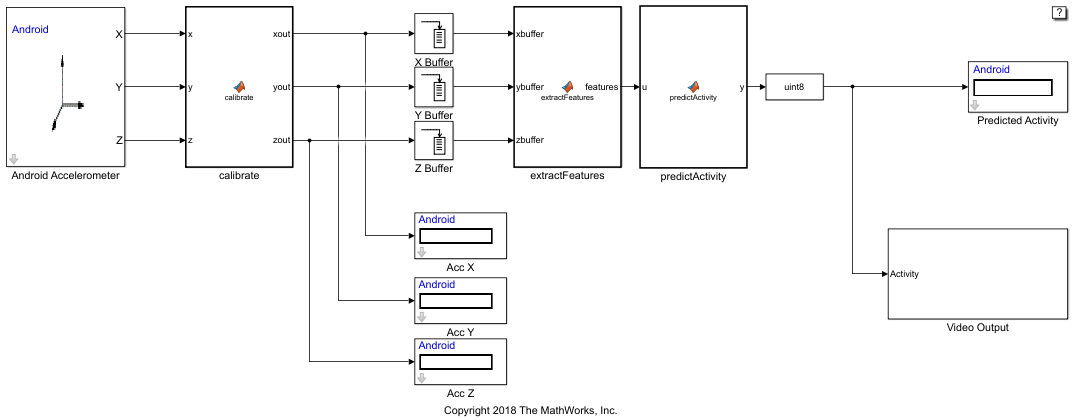
Human Activity Recognition Simulink Model for Smartphone Deployment

Generate code from a classification Simulink model prepared for deployment to a smartphone.

Human Activity Recognition Simulink Model for Fixed-Point Deployment

Generate code from a classification Simulink model prepared for fixed-point deployment.

Quantitatives Finanz- und Risikomanagement

Algorithmisches Trading

Kreditrisiko

Portfolio-Optimierung und Kapitalverteilung

Ökonometrische Modellierung

Enthaltene Beispiele

Unterrichtsmaterialien