KDEDistributionDiscriminator
R2026bDescription
The KDEDistributionDiscriminator object is a distribution discriminator that uses
kernel density estimation (KDE) to compute distribution confidence scores. The object contains
a threshold that you can use to separate observations into in-distribution (ID) and
out-of-distribution (OOD) data sets.
Creation
Create a KDEDistributionDiscriminator object using the networkDistributionDiscriminator function and setting the method input
argument to "kde". This object requires Statistics and Machine Learning Toolbox™.
Note
The object type depends on the method you specify when you use the networkDistributionDiscriminator function. The method determines how the
software computes the distribution confidence scores. You can set the method argument
to either "baseline", "odin",
"energy", "hbos", or "kde" (since R2026a). For more information, see Distribution Confidence Scores.
Properties
Object Functions
isInNetworkDistribution | Determine whether data is within the distribution of the network |
distributionScores | Distribution confidence scores |
Examples
More About
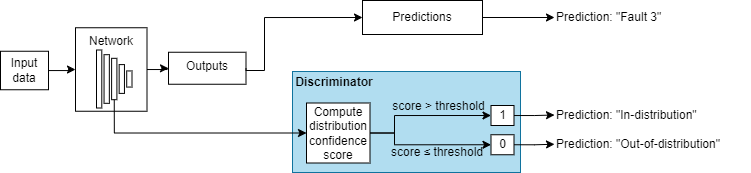
OOD data detection is a technique for assessing whether the inputs to a network are OOD. For methods that you apply after training, you can construct a discriminator which acts as an additional output of the trained network that classifies an observation as ID or OOD.
The discriminator works by finding a distribution confidence score for an input. You can then specify a threshold. If the score is less than or equal to that threshold, then the input is OOD. Two groups of metrics for computing distribution confidence scores are softmax-based and density-based methods. Softmax-based methods use the softmax layer to compute the scores. Density-based methods use the outputs of layers that you specify to compute the scores. For more information about how to compute distribution confidence scores, see Distribution Confidence Scores.
These images show how a discriminator acts as an additional output of a trained neural network.
Example Data Discriminators
| Example of Softmax-Based Discriminator | Example of Density-Based Discriminator |
|---|---|
|
For more information, see Softmax-Based Methods. |
For more information, see Density-Based Methods. |

References
[5] Jingkang Yang, Kaiyang Zhou, Yixuan Li, and Ziwei Liu, “Generalized Out-of-Distribution Detection: A Survey” August 3, 2022, http://arxiv.org/abs/2110.11334.
[6] Lee, Kimin, Kibok Lee, Honglak Lee, and Jinwoo Shin. “A Simple Unified Framework for Detecting Out-of-Distribution Samples and Adversarial Attacks.” arXiv, October 27, 2018. http://arxiv.org/abs/1807.03888.
Extended Capabilities
Version History
Introduced in R2026a

