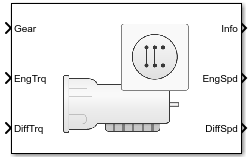
Ideal Fixed Gear Transmission
Ideal fixed gear transmission without clutch or synchronization

Libraries:
Powertrain Blockset /
Transmission /
Transmission Systems
Vehicle Dynamics Blockset /
Powertrain /
Transmission
Description
The Ideal Fixed Gear Transmission implements an idealized fixed-gear transmission without a clutch or synchronization. Use the block to model the overall gear ratio and power loss when you do not need a detailed transmission model, for example, in component-sizing, fuel economy, and emission studies. The block implements a transmission model with minimal parameterization or computational cost.
To specify the block efficiency calculation, for Efficiency factors, select either of these options.
| Setting | Block Implementation |
|---|---|
Gear only | Efficiency determined from a 1D lookup table that is a function of the gear. |
Gear, input torque, input speed, and temperature | Efficiency determined from a 4D lookup table that is a function of:
|
The block uses this equation to determine the transmission dynamics:
The block filters the gear command signal:
Neutral Gear
When Initial gear number, G_o is equal to
0, the initial gear is neutral. The block uses these
parameters to decouple the input flywheel from the downstream gearing.
Initial input velocity, omega_o
Initial neutral input velocity, omegainN_o
The block uses these equations for the neutral gear speed and flywheel.
Power Accounting
For the power accounting, the block implements these equations.
| Bus Signal | Description | Variable | Equations | ||
|---|---|---|---|---|---|
|
|
| Engine power | Peng | |
PwrDiffrntl | Differential power | Pdiff | |||
|
| PwrEffLoss | Mechanical power loss | Peffloss | ||
PwrDampLoss | Mechanical damping loss | Pdamploss | |||
|
| PwrStoredTrans | Rate change in rotational kinetic energy | Pstr | ||
The equations use these variables.
| bN | Engaged gear viscous damping |
| JN | Engaged gear rotational inertia |
| JF | Flywheel rotational inertia |
| ηN | Engaged gear efficiency |
| G | Engaged gear number |
| Gcmd | Gear number to engage |
| N | Engaged gear ratio |
| Ti | Applied input torque, typically from the engine crankshaft or dual mass flywheel damper |
| To | Applied load torque, typically from the differential or drive shaft |
| ωo | Initial input drive shaft rotational velocity |
| ωi, ώi | Applied drive shaft angular speed and acceleration |
| ωNo | Initial neutral gear input rotational velocity |
| ωneutral | Neutral gear drive shaft rotational velocity |
| τs | Shift time constant |
Ports
Inputs
Integer value of gear number to engage, Gcmd.
Applied input torque, Ti, typically from the engine crankshaft or dual mass flywheel damper, in N·m.
Applied load torque, To, typically from the differential, in N·m.
Oil temperature, in K. To determine the efficiency, the block uses a 4D lookup table that is a function of:
Gear
Input torque
Input speed
Oil temperature
Dependencies
To enable this port, set Efficiency factors
to Gear, input torque, input speed, and
temperature.
Output
Bus signal containing these block calculations.
| Signal | Description | Variable | Units | ||
|---|---|---|---|---|---|
Eng | EngTrq | Applied input torque, typically from the engine crankshaft or dual mass flywheel damper | Ti | N·m | |
EngSpd | Applied drive shaft angular speed input | ωi | rad/s | ||
Diff | DiffTrq | Applied load torque, typically from the differential | To | N·m | |
DiffSpd | Drive shaft angular speed output | ωo | rad/s | ||
Trans | TransSpdRatio | Input to output speed ratio at time t | Φ(t) | N/A | |
TransEta | Ratio of output power to input power | ηN | N/A | ||
TransGearCmd | Commanded gear | Ncmd | N/A | ||
TransGear | Engaged gear | N | N/A | ||
PwrInfo | PwrTrnsfrd |
| Engine power | Peng | W |
PwrDiffrntl | Differential power | Pdiff | W | ||
PwrNotTrnsfrd | PwrEffLoss | Mechanical power loss | Peffloss | W | |
PwrDampLoss | Mechanical damping loss | Pdamploss | W | ||
PwrStored | PwrStoredTrans | Rate change in rotational kinetic energy | Pstr | W | |
Applied drive shaft angular speed input, ωi, in rad/s.
Drive shaft angular speed output, ωo, in rad/s.
Parameters
To specify the block efficiency calculation, for Efficiency factors, select either of these options.
| Setting | Block Implementation |
|---|---|
Gear only | Efficiency determined from a 1D lookup table that is a function of the gear. |
Gear, input torque, input speed, and temperature | Efficiency determined from a 4D lookup table that is a function of:
|
Programmatic Use
To set the block parameter value programmatically, use
the set_param function.
To get the block parameter value
programmatically, use the get_param function.
| Parameter: | TransEffModelPopup |
| Values: | Gear only (default) | Gear, input torque, input speed, and
temperature |
| Data Types: | character vector |
Dependencies
| Setting Parameter To | Enables |
|---|---|
Gear only | Efficiency vector, eta |
Gear, input torque, input speed, and
temperature | Efficiency torque breakpoints, Trq_bpts Efficiency speed breakpoints, omega_bpts Efficiency temperature breakpoints, Temp_bpts Efficiency lookup table, eta_tbl |
Method that the block uses to switch the gear ratio during gear shifting.
Programmatic Use
To set the block
parameter value programmatically, use the set_param
function.
To get the block
parameter value programmatically, use the get_param
function.
| Parameter: | gearInterp |
| Values: | Nearest (default) | Linear | Flat | Cubic spline |
| Data Types: | character vector |
Select torque converter type, specified as None
or Mapped.
Programmatic Use
To set the block parameter value programmatically, use
the set_param function.
To get the block parameter value
programmatically, use the get_param function.
| Parameter: | TrqCnvrtrType |
| Values: | None (default) | Mapped |
| Data Types: | character vector |
Transmission
Vector of integer gear commands used to specify the number of transmission
speeds. Neutral gear is 0. For example, you can set these
parameter values.
| To Specify | Set Gear number, G To |
|---|---|
| Four transmission speeds, including neutral | [0,1,2,3,4] |
| Three transmission speeds, including neutral and reverse | [-1,0,1,2,3] |
| Five transmission speeds, including neutral and reverse | [-1,0,1,2,3,4,5] |
Vector dimensions for the Gear number vector, Gear ratio vector, Inertia vector, Damping vector, and Efficiency vector parameters must be equal.
Programmatic Use
To set the block parameter value programmatically, use
the set_param function.
To get the block parameter value
programmatically, use the get_param function.
| Parameter: | G |
| Values: | [-1,0,1,2,3,4,5] (default) | vector |
| Data Types: | double |
Torque breakpoints for efficiency table.
Programmatic Use
To set the block parameter value programmatically, use
the set_param function.
To get the block parameter value
programmatically, use the get_param function.
| Parameter: | Trq_bpts |
| Values: | [25,50,75,100,150,200,250] (default) | vector |
| Data Types: | double |
Dependencies
To enable this parameter, set Efficiency factors
to Gear, input torque, input speed, and
temperature.
Speed breakpoints for efficiency table, in rad/s.
Programmatic Use
To set the block parameter value programmatically, use
the set_param function.
To get the block parameter value
programmatically, use the get_param function.
| Parameter: | omega_bpts |
| Values: | [52.4 78.5 105 131 157 183 209 262
314 419 524] (default) | vector |
| Data Types: | double |
Dependencies
To enable this parameter, set Efficiency factors
to Gear, input torque, input speed, and
temperature.
Temperature breakpoints for efficiency table.
Programmatic Use
To set the block parameter value programmatically, use
the set_param function.
To get the block parameter value
programmatically, use the get_param function.
| Parameter: | Temp_bpts |
| Values: | [313 358] (default) | vector |
| Data Types: | double |
Dependencies
To enable this parameter, set Efficiency factors
to Gear, input torque, input speed, and
temperature.
Vector of gear ratios (that is, input speed to output speed) with indices
corresponding to the ratios specified in Gear number,
G. For neutral, set the gear ratio to 1. For
example, you can set these parameter values.
| To Specify Gear Ratios For | Set Gear number, G To | Set Gear ratio, N To |
|---|---|---|
| Four transmission speeds, including neutral | [0,1,2,3,4] | [1,4.47,2.47,1.47,1] |
| Five transmission speeds, including neutral and reverse | [-1,0,1,2,3,4,5] | [-4.47,1,4.47,2.47,
1.47,1,0.8] |
Vector dimensions for the Gear number vector, Gear ratio vector, Inertia vector, Damping vector, and Efficiency vector parameters must be equal.
Programmatic Use
To set the block parameter value programmatically, use
the set_param function.
To get the block parameter value
programmatically, use the get_param function.
| Parameter: | N |
| Values: | [-4.47,4.47,4.47,2.47,1.47,1,0.8] (default) | vector |
| Data Types: | double |
Vector of gear rotational inertias, JN, with indices corresponding to the inertias specified in Gear number, G, in kg*m^2. For example, you can set these parameter values.
| To Specify Inertia For | Set Gear number, G To | Set Inertia, J To |
|---|---|---|
| Four gears, including neutral | [0,1,2,3,4] | [0.01,2.28,2.04,
0.32,0.028] |
| Inertia for five gears, including reverse and neutral | [-1,0,1,2,3,4,5] | [2.28,0.01,2.28,
2.04,0.32,0.028,0.01] |
Vector dimensions for the Gear number vector, Gear ratio vector, Inertia vector, Damping vector, and Efficiency vector parameters must be equal.
Programmatic Use
To set the block parameter value programmatically, use
the set_param function.
To get the block parameter value
programmatically, use the get_param function.
| Parameter: | Jout |
| Values: | [0.128 0.01 0.128 0.1 0.062 0.028
0.01] (default) | vector |
| Data Types: | double |
Vector of gear viscous damping coefficients, bN, with indices corresponding to the coefficients specified in Gear number, G, in N·m·s/rad. For example, you can set these parameter values.
| To Specify Damping For | Set Gear number, G To | Set Damping, b To |
|---|---|---|
| Four gears, including neutral | [0,1,2,3,4] | [0.001,0.003,
0.0025,0.002,0.001] |
| Five gears, including reverse and neutral | [-1,0,1,2,3,4,5] | [0.003,0.001, 0.003,0.0025,
0.002,0.001,0.001] |
Vector dimensions for the Gear number vector, Gear ratio vector, Inertia vector, Damping vector, and Efficiency vector parameters must be equal.
Programmatic Use
To set the block parameter value programmatically, use
the set_param function.
To get the block parameter value
programmatically, use the get_param function.
| Parameter: | bout |
| Values: | [.003 .001 .003 .0025 .002 .001
.001] (default) | vector |
| Data Types: | double |
Vector of gear mechanical efficiency, ηN, with indices corresponding to the efficiencies specified in Gear number, G. For example, you can set these parameter values.
| To Specify Efficiency For | Set Gear number, G To | Set Efficiency, eta To |
|---|---|---|
| Four gears, including neutral | [0,1,2,3,4] | [0.9,0.9,0.9,0.9,0.95] |
| Five gears, including reverse and neutral | [-1,0,1,2,3,4,5] | [0.9,0.9,0.9,
0.9,0.9,0.95,0.95] |
Vector dimensions for the Gear number vector, Gear ratio vector, Inertia vector, Damping vector, and Efficiency vector parameters must be equal.
Programmatic Use
To set the block parameter value programmatically, use
the set_param function.
To get the block parameter value
programmatically, use the get_param function.
| Parameter: | eta |
| Values: | [0.9,0.9,0.9,0.9,0.9,0.95,0.95] (default) | vector |
| Data Types: | double |
Dependencies
To enable this parameter, set Efficiency factors
to Gear only.
Table of gear mechanical efficiency, ηN as a function of gear, input torque, input speed, and temperature.
Programmatic Use
To set the block parameter value programmatically, use
the set_param function.
To get the block parameter value
programmatically, use the get_param function.
| Parameter: | eta_tbl |
| Values: | array |
| Data Types: | double |
Dependencies
To enable this parameter, set Efficiency factors
to Gear, input torque, input speed, and
temperature.
Transmission initial output rotational velocity, ωo, in rad/s.
Programmatic Use
To set the block parameter value programmatically, use
the set_param function.
To get the block parameter value
programmatically, use the get_param function.
| Parameter: | omega_o |
| Values: | 0 (default) | scalar |
| Data Types: | double |
Initial neutral gear input rotational velocity, ωNo, in rad/s.
Programmatic Use
To set the block parameter value programmatically, use
the set_param function.
To get the block parameter value
programmatically, use the get_param function.
| Parameter: | omegainN_o |
| Values: | 0 (default) | scalar |
| Data Types: | double |
Torque converter
Vector of turbine speed to impeller speed ratios. Breakpoints for the capacity and torque multiplication vectors.
Programmatic Use
To set the block parameter value programmatically, use
the set_param function.
To get the block parameter value
programmatically, use the get_param function.
| Parameter: | phi |
| Values: | [0 0.50 0.60 0.70 0.80 0.87 0.92 0.94
0.96 0.97] (default) | vector |
| Data Types: | double |
Dependencies
To enable this parameter, select Mapped for
the Torque converter parameter.
Capacity vector, specified as a vector.
Programmatic Use
To set the block parameter value programmatically, use
the set_param function.
To get the block parameter value
programmatically, use the get_param function.
| Parameter: | psi |
| Values: | [12.2938 12.8588 13.1452 13.6285
14.6163 16.2675 19.3503 22.1046 29.9986
50.00] (default) | vector |
| Data Types: | double |
Dependencies
To enable this parameter, select Mapped for
the Torque converter parameter.
Vector of turbine torque to impeller speed ratios.
Programmatic Use
To set the block parameter value programmatically, use
the set_param function.
To get the block parameter value
programmatically, use the get_param function.
| Parameter: | zeta |
| Values: | [2.2320 1.5462 1.4058 1.2746 1.1528
1.0732 1.0192 0.9983 0.9983 0.9983] (default) | vector |
| Data Types: | double |
Dependencies
To enable this parameter, select Mapped for
the Torque converter parameter.
Set speed ratio threshold that engages clutch lock-up.
Programmatic Use
To set the block parameter value programmatically, use
the set_param function.
To get the block parameter value
programmatically, use the get_param function.
| Parameter: | philu |
| Values: | 0.96 (default) | scalar |
| Data Types: | double |
Dependencies
To enable this parameter, select Mapped for
the Torque converter parameter.
Set the minimum impeller speed that disengages clutch lock-up, in rad/s.
Programmatic Use
To set the block parameter value programmatically, use
the set_param function.
To get the block parameter value
programmatically, use the get_param function.
| Parameter: | omegau |
| Values: | 0 (default) | scalar |
| Data Types: | double |
Dependencies
To enable this parameter, select Mapped for
the Torque converter parameter.
Set the minimum impeller speed that engages clutch lock-up, in rad/s.
Programmatic Use
To set the block parameter value programmatically, use
the set_param function.
To get the block parameter value
programmatically, use the get_param function.
| Parameter: | omegal |
| Values: | 0 (default) | scalar |
| Data Types: | double |
Dependencies
To enable this parameter, select Mapped for
the Torque converter parameter.
Torque converter coupling time-constant, in s.
Programmatic Use
To set the block parameter value programmatically, use
the set_param function.
To get the block parameter value
programmatically, use the get_param function.
| Parameter: | tauTC |
| Values: | 0.1 (default) | scalar |
| Data Types: | double |
Dependencies
To enable this parameter, select Mapped for
the Torque converter parameter.
Extended Capabilities
C/C++ Code Generation
Generate C and C++ code using Simulink® Coder™.
Version History
Introduced in R2017aStarting in R2026a, you can specify Torque converter as
None or Mapped. If you
specify Mapped you can set these parameters:
Speed ratio vector, phi []
Capacity vector, psi [(rad/s)/(N*m)^0.5]
Torque ratio vector, zeta []
Lock-up speed ratio threshold, philu []
Lock-up disengagement speed, omegau [rad/s]
Minimum lock-up engagement speed, omegal [rad/s]
Torque converter coupling time-constant, tauTC [s]
See Also
MATLAB Command
You clicked a link that corresponds to this MATLAB command:
Run the command by entering it in the MATLAB Command Window. Web browsers do not support MATLAB commands.
Website auswählen
Wählen Sie eine Website aus, um übersetzte Inhalte (sofern verfügbar) sowie lokale Veranstaltungen und Angebote anzuzeigen. Auf der Grundlage Ihres Standorts empfehlen wir Ihnen die folgende Auswahl: .
Sie können auch eine Website aus der folgenden Liste auswählen:
So erhalten Sie die bestmögliche Leistung auf der Website
Wählen Sie für die bestmögliche Website-Leistung die Website für China (auf Chinesisch oder Englisch). Andere landesspezifische Websites von MathWorks sind für Besuche von Ihrem Standort aus nicht optimiert.
Amerika
- América Latina (Español)
- Canada (English)
- United States (English)
Europa
- Belgium (English)
- Denmark (English)
- Deutschland (Deutsch)
- España (Español)
- Finland (English)
- France (Français)
- Ireland (English)
- Italia (Italiano)
- Luxembourg (English)
- Netherlands (English)
- Norway (English)
- Österreich (Deutsch)
- Portugal (English)
- Sweden (English)
- Switzerland
- United Kingdom (English)