Generalisierte lineare Regression
R2026aUm eine höhere Präzision und mehr Auswahlmöglichkeiten für die Link-Funktion bei niederdimensionalen bis mitteldimensionalen Datensätzen zu erreichen, können Sie ein generalisiertes lineares Regressionsmodell mithilfe von fitglm anpassen. Für eine multinomiale logistische Regression passen Sie ein Modell mithilfe von fitmnr an.
Um die Berechnungszeit bei höherdimensionalen Datensätzen zu reduzieren, trainieren Sie ein binäres, lineares Klassifizierungsmodell wie ein logistisches Regressionsmodell mithilfe von fitclinear. Ebenfalls können Sie ein mehrklassiges ECOC-Modell (Error-Correcting Output Codes, fehlerkorrigierende Ausgangscodes) aus logistischen Regressionsmodellen mithilfe von fitcecoc effizient trainieren.
Für nichtlineare Klassifizierung mit Big Data können Sie ein binäres Gauss-Kernel-Klassifizierungsmodell mit logistischer Regression mithilfe von fitckernel trainieren.
Blöcke
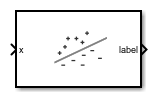 | ClassificationLinear Predict | Classify observations using linear classification model (Seit R2023a) |
Funktionen
Objekte
Themen
Generalisierte lineare Regression
- Generalized Linear Models
Generalized linear models use linear methods to describe a potentially nonlinear relationship between predictor terms and a response variable. - Generalized Linear Model Workflow
Fit a generalized linear model and analyze the results. - Fitting Data with Generalized Linear Models
Fit and evaluate generalized linear models usingglmfitandglmval. - Predict Class Labels Using ClassificationLinear Predict Block
This example shows how to use the ClassificationLinear Predict block for label prediction in Simulink®. (Seit R2023a) - Logistic Regression with Tall Arrays
This example shows how to use logistic regression and other techniques to perform data analysis on tall arrays. - Wilkinson Notation
Wilkinson notation provides a way to describe regression and repeated measures models without specifying coefficient values.
Multinomiale logistische Regression
- Multinomial Models for Nominal Responses
A nominal response variable has a restricted set of possible values with no natural order between them. A nominal response model explains and predicts the probability that an observation is in each category of a categorical response variable. - Multinomial Models for Ordinal Responses
An ordinal response variable has a restricted set of possible values that fall into a natural order. An ordinal response model describes the relationship between the cumulative probabilities of the categories and predictor variables. - Multinomial Models for Hierarchical Responses
A hierarchical multinomial response variable (also known as a sequential or nested multinomial response) has a restricted set of possible values that fall into hierarchical categories. The hierarchical multinomial regression models are extensions of binary regression models based on conditional binary observations.

