Communications Applications
Modulation
Modulation varies the amplitude, phase, or frequency of a
carrier signal with reference to a message
signal. The modulate function modulates a message
signal with a specified modulation method.
The basic syntax for the modulate function is
y = modulate(x,fc,fs,'method',opt)
where:
xis the message signal.fcis the carrier frequency.fsis the sampling frequency.methodis a flag for the desired modulation method.optis any additional argument that the method requires. (Not all modulation methods require an option argument.)
The table below summarizes the modulation methods provided; see the documentation
for modulate, demod, and vco for complete details on
each.
Method | Description |
|---|---|
| Amplitude modulation, double sideband, suppressed carrier |
| Amplitude modulation, double sideband, transmitted carrier |
| Amplitude modulation, single sideband |
| Frequency modulation |
| Phase modulation |
| Pulse position modulation |
| Pulse width modulation |
| Quadrature amplitude modulation |
If the input x is an array rather than a vector,
modulate modulates each column of the array.
To obtain the time vector that modulate uses to compute the
modulated signal, specify a second output parameter:
[y,t] = modulate(x,fc,fs,'method',opt)
Demodulation
The demod function performs demodulation,
that is, it obtains the original message signal from the modulated signal:
The syntax for demod is
x = demod(y,fc,fs,'method',opt)
demod uses any of the methods shown for
modulate, but the syntax for quadrature amplitude
demodulation requires two output parameters:
[X1,X2] = demod(y,fc,fs,'qam')
If the input y is an array, demod
demodulates all columns.
Try modulating and demodulating a signal. A 50 Hz sine wave sampled at 1000 Hz is
t = (0:1/1000:2);
x = sin(2*pi*50*t);
With a carrier frequency of 200 Hz, the modulated and demodulated versions of this signal are
y = modulate(x,200,1000,'am');
z = demod(y,200,1000,'am');
To plot portions of the original, modulated, and demodulated signal:
figure; plot(t(1:150),x(1:150)); title('Original Signal');
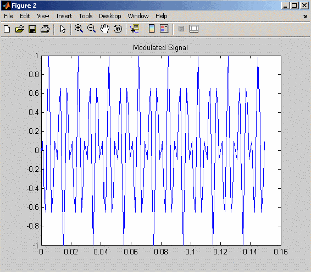
figure; plot(t(1:150),y(1:150)); title('Modulated Signal');
figure; plot(t(1:150),z(1:150)); title('Demodulated Signal');
Original Signal

Modulated Signal
Demodulated Signal

Note
The demodulated signal is attenuated because demodulation includes two steps: multiplication and lowpass filtering. The multiplication produces a component with frequency centered at 0 Hz and a component with frequency at twice the carrier frequency. The filtering removes the higher frequency component of the signal, producing the attenuated result.
Voltage Controlled Oscillator
The voltage controlled oscillator function vco creates a signal
that oscillates at a frequency determined by the input vector. The basic syntax for
vco is
y = vco(x,fc,fs)
where fc is the carrier frequency and fs is
the sampling frequency.
To scale the frequency modulation range, use
y = vco(x,[Fmin Fmax],fs)
In this case, vco scales the frequency modulation range so
values of x on the interval [-1 1]
map to oscillations of frequency on [Fmin Fmax].
If the input x is an array, vco produces an
array whose columns oscillate according to the columns
of x.
See FFT-Based Time-Frequency Analysis for an
example using the vco function.

