modulate
R2026bModulation for communications simulation
Syntax
Description
Examples
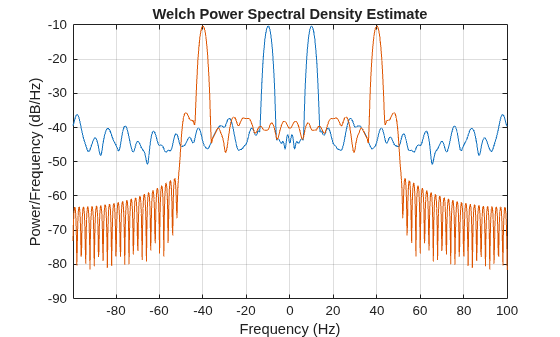
Generate a 10 Hz sinusoidal signal sampled at a rate of 200 Hz for 1 second. Embed the sinusoid in white Gaussian noise of variance 0.01.
fs = 200; t = 0:1/fs:1; x = sin(2*pi*10*t) + randn(size(t))/10;
Single-sideband amplitude modulate the signal with a carrier frequency of 50 Hz. Compute and display the new Welch's power spectral density estimates.
y = modulate(x,50,fs,'amssb'); pwelch([x;y]',hamming(100),80,1024,fs,'centered')
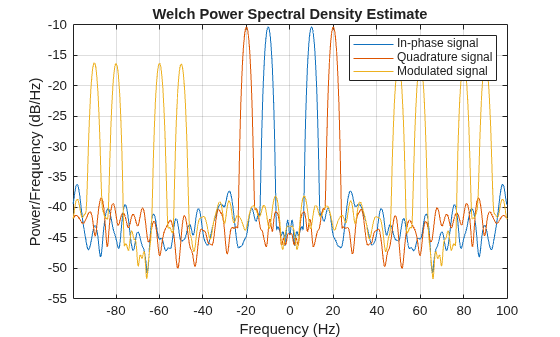
Generate two sinusoidal signals frequencies of 10 Hz and 20 Hz, sampled at a rate of 200 Hz for 1 second. Embed the sinusoids in white Gaussian noise of variance 0.01.
fs = 200; t = 0:1/fs:1; i = sin(2*pi*10*t) + randn(size(t))/10; q = sin(2*pi*20*t) + randn(size(t))/10;
Create a quadrature amplitude modulated signal from signals i and q using a carrier frequency of 70 Hz. Compute the Welch power spectral density estimates of the original and modulated sequences. Use a 100-sample Hamming window with 80 samples of overlap. Specify an FFT length of 1024.
y = modulate(i,70,fs,'qam',q); pwelch([i;q;y]',hamming(100),80,1024,fs,'centered') legend('In-phase signal','Quadrature signal','Modulated signal')
Input Arguments
Message signal, specified as a real vector or matrix.
Example: sin(2*pi*25*[0:(1/200):1])
Carrier frequency used to modulate the message signal, specified as a real positive scalar.
Sample rate, specified as a real positive scalar.
Method of modulation used, specified as one of these:
amdsb-scoram— Amplitude modulation, double sideband, suppressed carrier. Multipliesxby a sinusoid of frequencyfc.y = x.*cos(2*pi*fc*t)
amdsb-tc— Amplitude modulation, double sideband, transmitted carrier. Subtracts scalaroptfromxand multiplies the result by a sinusoid of frequencyfc.y = (x-opt).*cos(2*pi*fc*t)
If you do not specify the
optparameter,modulateuses a default ofmin(min(x))so that the message signal(x-opt)is entirely nonnegative and has a minimum value of 0.amssb— Amplitude modulation, single sideband. Multipliesxby a sinusoid of frequencyfcand adds the result to the Hilbert transform ofxmultiplied by a phase-shifted sinusoid of frequencyfc.y = x.*cos(2*pi*fc*t)+imag(hilbert(x)).*sin(2*pi*fc*t)
This effectively removes the upper sideband.
fm— Frequency modulation. Creates a sinusoid with instantaneous frequency that varies with the message signalx.y = cos(2*pi*fc*t + opt*cumsum(x))
cumsumis a rectangular approximation of the integral ofx.modulateusesoptas the constant of frequency modulation. If you do not specify theoptparameter,modulateuses a default ofopt = (fc/fs)*2*pi/(max(max(x)))so the maximum frequency excursion fromfcisfcHz.pm— Phase modulation. Creates a sinusoid of frequencyfcwhose phase varies with the message signalx.y = cos(2*pi*fc*t + opt*x)
modulateusesoptas the constant of phase modulation. If you do not specify theoptparameter,modulateuses a default ofopt = pi/(max(max(x)))so the maximum phase excursion is π radians.pwm— Pulse-width modulation. Creates a pulse-width modulated signal from the pulse widths inx. The elements ofxmust be between 0 and 1, specifying the width of each pulse in fractions of a period. The pulses start at the beginning of each period, that is, they are left justified.modulate(x,fc,fs,'pwm','centered')yields pulses centered at the beginning of each period. The length ofyislength(x)*fs/fc.ppm— Pulse-position modulation. Creates a pulse-position modulated signal from the pulse positions inx. The elements ofxmust be between 0 and 1, specifying the left edge of each pulse in fractions of a period.optis a scalar between 0 and 1 that specifies the length of each pulse in fractions of a period. The default foroptis0.1. The length ofyislength(x)*fs/fc.qam— Quadrature amplitude modulation. Creates a quadrature amplitude modulated signal from signalsxandopt.y = x.*cos(2*pi*fc*t) + opt.*sin(2*pi*fc*t)
The input argument
optmust be the same size asx.
Optional input, specified for some methods. Refer to method for
more details on how to use opt.
Data Types: single | double | char | string
Complex Number Support: Yes
Output Arguments
Modulated message signal, returned as a real vector or matrix. Except for the
methods pwm and ppm, y is the
same size as x.
Internal time array used by modulate in its computations,
specified as a real vector.
Extended Capabilities
C/C++ Code Generation
Generate C and C++ code using MATLAB® Coder™.
GPU Code Generation
Generate CUDA® code for NVIDIA® GPUs using GPU Coder™.
The modulate
function fully supports thread-based environments. For more information, see Run MATLAB Functions in Thread-Based Environment.
Version History
Introduced before R2006aYou can use modulate in thread-based
environments. For more information, see Run MATLAB Functions in Thread-Based Environment.
Generate C and C++ code for the modulate function. You must have
MATLAB®
Coder™ to use this functionality.
MATLAB Command
You clicked a link that corresponds to this MATLAB command:
Run the command by entering it in the MATLAB Command Window. Web browsers do not support MATLAB commands.
Website auswählen
Wählen Sie eine Website aus, um übersetzte Inhalte (sofern verfügbar) sowie lokale Veranstaltungen und Angebote anzuzeigen. Auf der Grundlage Ihres Standorts empfehlen wir Ihnen die folgende Auswahl: .
Sie können auch eine Website aus der folgenden Liste auswählen:
So erhalten Sie die bestmögliche Leistung auf der Website
Wählen Sie für die bestmögliche Website-Leistung die Website für China (auf Chinesisch oder Englisch). Andere landesspezifische Websites von MathWorks sind für Besuche von Ihrem Standort aus nicht optimiert.
Amerika
- América Latina (Español)
- Canada (English)
- United States (English)
Europa
- Belgium (English)
- Denmark (English)
- Deutschland (Deutsch)
- España (Español)
- Finland (English)
- France (Français)
- Ireland (English)
- Italia (Italiano)
- Luxembourg (English)
- Netherlands (English)
- Norway (English)
- Österreich (Deutsch)
- Portugal (English)
- Sweden (English)
- Switzerland
- United Kingdom (English)