Acquire Counter Input Data
R2026bThis topic shows how to configure counter input channels on NI devices and read measurement data. You learn how to:
Read a single edge count or frequency value from a counter channel.
Reset counters between reads.
Acquire counter data in a foreground acquisition.
Use addinput to
add a counter channel to the DataAcquisition object. You can acquire
counter input data using these channels. The counter input channels support these
measurement types: "EdgeCount", "Frequency",
"PulseWidth", and "Position".
The following examples use an NI cDAQ-9179 chassis with an NI 9402 counter module
(cDAQ1Mod5) and an NI 9205 analog input module
(cDAQ1Mod1).
Acquire a Single Count
This example shows how to acquire a single count of falling
edges from an NI 9402 with device ID cDAQ1Mod5. The example
assumes that an external source provides a signal to the counter channel, and
that the count accumulates over time.
Create a DataAcquisition object using the daq function.
d = daq("ni");Add a counter input channel with an edge count measurement type using the
addinput function.
ch = addinput(d,"cDAQ1Mod5","ctr0","EdgeCount")
ch =

    Index    Type      Device       Channel    Measurement Type    Range         Name
    _____    ____    ___________    _______    ________________    _____    ________________

      1      "ci"    "cDAQ1Mod5"    "ctr0"       "EdgeCount"       "n/a"    "cDAQ1Mod5_ctr0"
Change the channel ActiveEdge property to
'Falling' and view the channel properties.
ch.ActiveEdge = 'Falling';
get(ch)
ActiveEdge: Falling
CountDirection: Increment
InitialCount: 0
Terminal: 'PFI0'
Name: 'cDAQ1Mod5_ctr0'
ID: 'ctr0'
Device: [1x1 daq.ni.DeviceInfo]
MeasurementType: 'EdgeCount'Acquire a single scan reading of the counter. By default, the read function returns data as a
timetable.
count = read(d)
count =

  timetable

    Time     cDAQ1Mod3_ctr0
    _____    ______________

    0 sec         133
Reset counters to the initial count using resetcounters, then acquire an updated count value. To
retrieve the count as a numeric scalar, specify
OutputFormat as "Matrix". The
acquired count value is the number of detections since the reset.
resetcounters(d);
count = read(d,OutputFormat="Matrix")
count = 71
Acquire a Single Frequency Count
This example shows how to acquire a single scan of frequency
measurement from an NI 9402 with device ID cDAQ1Mod5.
Create a DataAcquisition object.
d = daq("ni");Add a counter channel with a frequency measurement type.
addinput(d,"cDAQ1Mod5","ctr0","Frequency")
    Index    Type      Device       Channel    Measurement Type    Range         Name
    _____    ____    ___________    _______    ________________    _____    ________________

      1      "ci"    "cDAQ1Mod5"    "ctr0"       "Frequency"       "n/a"    "cDAQ1Mod5_ctr0"
Acquire a single scan of counter data. The read
function returns the frequency measurement in Hz.
f = read(d,OutputFormat="Matrix")f = 9.5877e+03
If the function returns NaN, verify that the input
signal voltage complies with TTL specifications and that the signal
frequency is within the supported range of the device.
Acquire Counter Data in Foreground
This example shows how to acquire rising edge count data from
an NI 9402 with device ID cDAQ1Mod5, and plot the acquired
data.
Create a DataAcquisition object.
d = daq("ni");Add a counter input channel with an edge count measurement type.
addinput(d,"cDAQ1Mod5","ctr0","EdgeCount")
    Index    Type      Device       Channel    Measurement Type    Range         Name
    _____    ____    ___________    _______    ________________    _____    ________________

      1      "ci"    "cDAQ1Mod5"    "ctr0"       "EdgeCount"       "n/a"    "cDAQ1Mod5_ctr0"
Add an analog input channel with a voltage measurement type.
A DataAcquisition object with only counter channels
defaults to on-demand mode and supports only single-scan reads. To perform a
foreground acquisition, counter channels require a sample clock source,
which could be an external clock or an analog input channel from a clocked
device on the same CompactDAQ chassis. Alternatively, the analog input
channel could be on the same device as the counter channel.
This example uses an analog channel from NI 9205 device on the same
chassis with the device ID cDAQ1Mod1.
addinput(d,"cDAQ1Mod1","ai1","Voltage");
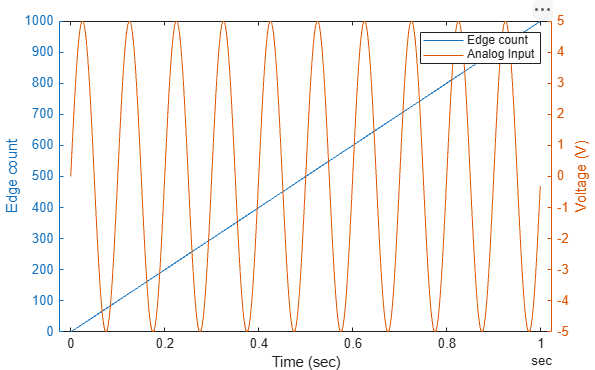
Acquire the data for one second and plot the results.
data = read(d,seconds(1));
yyaxis left
plot(data.Time,data.cDAQ1Mod5_ctr0)
ylabel("Edge count")
yyaxis right
plot(data.Time,data.cDAQ1Mod1_ai1)
ylabel("Voltage (V)")
xlabel("Time (sec)")
legend("Edge count","Analog Input")
The plot displays the results from both channels: the edge count as a linear ramp on the left axis (each detected edge increments the count) and the analog input as a time-varying voltage signal on the right axis.
See Also
Functions
daq|addinput|read|resetcounters

