Gyrator
R2026bIdeal gyrator in electrical systems
Gyrator block
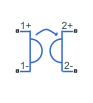
To add a block to a model, double-click the canvas and start typing the block name. Then, select the block from the list.
Libraries:
Simscape /
Foundation Library /
Electrical /
Electrical Elements
Description
Gyrators can be used to implement an inductor with a capacitor. The main benefit is that an equivalent inductance can be created with a much smaller physically sized capacitance. In practice, a gyrator is implemented with an op-amp plus additional passive components.
The Gyrator block models an ideal gyrator with no losses, described with the equations
where:
I1 is the current flowing into the + terminal of the primary winding.
I2 is the current flowing out of the + terminal of the secondary winding.
V1 is the voltage across the primary winding.
V2 is the voltage across the secondary winding.
G is the gyration conductance.
The two electrical networks connected to the primary and secondary windings must each have their own Electrical Reference block.
Variables
To set the priority and initial target values for the block variables prior to simulation, use the Initial Targets section in the block dialog box or Property Inspector. For more information, see Set Priority and Initial Target for Block Variables.
Nominal values provide a way to specify the expected magnitude of a variable in a model. Using system scaling based on nominal values increases the simulation robustness. Nominal values can come from different sources, one of which is the Nominal Values section in the block dialog box or Property Inspector. For more information, see Modify Nominal Values for a Block Variable.
Ports
Conserving
Parameters
Extended Capabilities
Version History
Introduced in R2008a

