Transformers
R2026bInductors, tap changing transformer, two- and three-winding
transformers
Increase or decrease AC voltages using transformers. Regulate voltage by varying the turns ratio using a tap-changing transformer.
For help deciding which block to use to model a transformer for your application, see Choose Blocks to Model Transformers.
Simscape Blocks
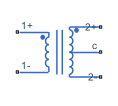 | Center-Tapped Transformer | Single-phase center-tapped transformer (Since R2023b) |
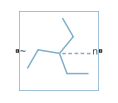 | Earthing Transformer | Three-phase earthing transformer in zigzag configuration |
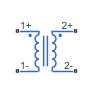 | Mutual Inductor | Mutual inductor model with nominal inductance optional tolerances for each winding, operating limits and faults |
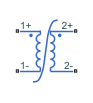 | Nonlinear Transformer | Transformer with nonideal core |
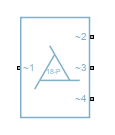 | Phase-Shifting Transformer | 12-pulse, 18-pulse, 24-pulse, or 48-pulse phase-shifting transformer (Since R2024a) |
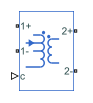 | Tap-Changing Transformer | Single-phase tap-changing transformer |
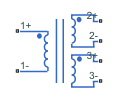 | Three-Winding Mutual Inductor | Three coupled inductors |
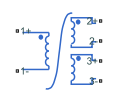 | Three-Winding Nonlinear Transformer | Single-phase nonlinear three-winding transformer |
 | Three-Winding Transformer (Three-Phase) | Three-phase linear nonideal wye- and delta-configurable three-winding transformer with saturation capability |
 | Two-Winding Transformer (Three-Phase) | Three-phase linear nonideal wye- and delta-configurable two-winding transformer with saturation capability |
 | Zigzag-Delta-Wye Transformer | Linear, non-ideal zigzag-delta-wye transformer with three-limb core with saturation capability |
Featured Examples
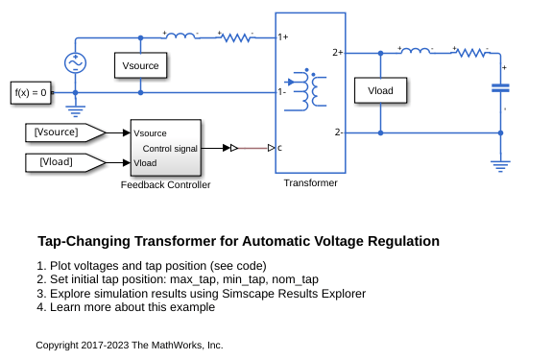
Tap-Changing Transformer for Automatic Voltage Regulation
Use a single-phase tap-changing transformer to control the voltage across an RLC load. The system contains an AC voltage source that generates a 60 Hz sine wave (located on the left-hand side of the circuit). The root-mean-square value for the voltage generated by this source is 120 V (reference voltage).

