Piston
R2026bPiston mechanism of reciprocating combustion engine
Piston block

To add a block to a model, double-click the canvas and start typing the block name. Then, select the block from the list.
Libraries:
Simscape /
Driveline /
Engines & Motors
Description
The Piston block represents the piston mechanism of a reciprocating combustion engine. The Piston block accounts for the instantaneous torque transmitted to the engine crankshaft, which enables you to simulate vibrations in the drivetrain due to piston revolution. To model a multi-piston engine, use the Piston Engine block.
Port B represents a piston container such as an engine block and port F represents the rotating crankshaft. The piston force follows from the cylinder pressure and cross-sectional area. The block obtains the combustion pressure from a lookup table parameterized in terms of the crank angle and, optionally, the crank angular velocity and engine throttle level.
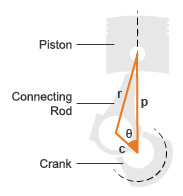
The crank torque follows from the piston force and crank angle, the crank and connecting rod lengths. In terms of these inputs, the ratio of the piston force and crank torque is
where:
FB is the instantaneous piston force associated with the base port.
TF is the instantaneous crank torque associated with the follower port.
c is the crank length.
θ is the instantaneous crank angle.
r is the connecting rod length.
Piston Dimensions
Port T lets you specify the engine throttle level as a fraction between 0 and 1. This fraction corresponds to the percentage of full power generated. The block uses the data at point T whenever the pressure lookup table in the block property inspector is parameterized only in terms of the crank angle.
Ports
Input
Physical signal input port that specifies engine throttle setting.
Programmatic Use
Port:
T
Output
Physical signal output port that returns the fuel consumption rate.
Dependencies
To enable this port, set Fuel consumption model to one of the following.
Constant per revolutionFuel consumption by speed and torqueBrake specific fuel consumption by speed and torqueBrake specific fuel consumption by speed and brake mean effective pressure
Programmatic Use
Port:
FC
Conserving
Rotational mechanical conserving port associated with the piston container.
Programmatic Use
Port:
B
Rotational mechanical conserving port that connects to the engine crankshaft.
Programmatic Use
Port:
F
Parameters
Main
Inside diameter of the piston cylinder wall. The Piston block uses this measurement to compute the torque table. You must specify a value greater than zero.
Programmatic Use
Parameter:
bore
Distance from the fully retracted position to the fully extended position of the piston. The Piston block uses this measurement to convert pressure on the piston into torque values. You must specify a value greater than zero.
Programmatic Use
Parameter:
stroke
Distance from the center of the piston pin hole to the center of the crankshaft hole in the piston rod. The block uses this measurement to convert pressure on the piston into torque. You must specify a value greater than zero.
Programmatic Use
Parameter:
rod
Number of piston phases required to intake, compress, combust, and exhaust the combustion gases. Typically, engines are two-stroke or four-stroke. You must use a multiple of two.
Programmatic Use
Parameter:
stroke_num
Parameter group that you want the block to use to parameterize the pressure data.
Programmatic Use
| Parameter: | parameterization |
| Values: | "sdl.enum.piston_parameterization.Angle" | "sdl.enum.piston_parameterization.AngleThrottle" | "sdl.enum.piston_parameterization.AngleThrottleVelocity" |
Angle of the piston crank starting at or above the minimum angle and ending at or below the maximum angle. You can calculate the minimum or maximum angle by multiplying the number of strokes by -90 degrees or 90 degrees, respectively. You must specify at least two values.
Each element in Crank angle vector corresponds to an element in Pressure vector (gauge) or the M-row of Pressure matrix (gauge) or each Pressure 3D matrix (gauge) matrix.
Programmatic Use
Parameter:
angle_vector
Different throttle positions that correspond to the pressures in the Pressure matrix (gauge) or Pressure 3D matrix (gauge) parameters. The throttle position must remain in the range [0,1] with 0 representing no throttle and 1 representing full throttle.
Each element in Throttle vector corresponds to the N-column of Pressure matrix (gauge) or each Pressure 3D matrix (gauge) matrix.
Dependencies
To enable this parameter, set Pressure
parameterization to By crank angle and
throttle or By crank angle, throttle,
and crank velocity.
Programmatic Use
Parameter:
throttle_vector
Different crank velocities that correspond to pressures in Pressure 3D matrix (gauge).
Each element in Crank velocity vector corresponds to one of the O-matrices of Pressure 3D matrix (gauge).
Dependencies
To enable this parameter, set Pressure
parameterization to By crank angle,
throttle, and crank velocity.
Programmatic Use
Parameter:
velocity_vector
Vector of pressure values that correspond to different crank angle positions.
Dependencies
To enable this parameter, set Pressure
parameterization to By crank
angle.
Programmatic Use
Parameter:
pressure_vector
Matrix of pressure values that correspond to different crank angle and throttle
combinations. The default value is [0, 0, 0, 0; 0, .9, 2.4, 3;
0, 6, 16, 20; 0, 15, 40, 50; 0, 6, 16, 20; 0, 3, 8, 10; 0, 2.4, 6.4,
8; 0, 0, 0, 0]
bar.
The elements of Crank angle vector correspond to the M-rows in Pressure matrix (gauge). The elements of Throttle vector correspond to the N-columns in Pressure matrix (gauge).
Dependencies
To enable this parameter, set Pressure
parameterization to By crank angle and
throttle.
Programmatic Use
Parameter:
pressure_matrix
Concatenated matrix of pressure values that correspond to the various crank angle,
throttle, and crank velocity combinations. The default value is
cat(3, [0, 0, 0, 0; 0, .9, 2.4, 3; 0, 6, 16, 20; 0, 15, 40,
50; 0, 6, 16, 20; 0, 3, 8, 10; 0, 2.4, 6.4, 8; 0, 0, 0, 0], [0, 0,
0, 0; 0, .9, 2.4, 3; 0, 6, 16, 20; 0, 15, 40, 50; 0, 6, 16, 20; 0,
3, 8, 10; 0, 2.4, 6.4, 8; 0, 0, 0, 0], [0, 0, 0, 0; 0, .9, 2.4, 3;
0, 6, 16, 20; 0, 15, 40, 50; 0, 6, 16, 20; 0, 3, 8, 10; 0, 2.4, 6.4,
8; 0, 0, 0, 0])
bar.
The elements of Crank angle vector correspond to the M-rows. The elements of Throttle vector correspond to the N-columns. The elements of Crank velocity vector correspond to the matrices you concatenate along dimension O.
By default, M = 8, N = 4, and O = 3.
Dependencies
To enable this parameter, set Pressure
parameterization to By crank angle,
throttle, and crank velocity.
Aggregate viscous friction coefficient of the main and rod bearings. The block uses this parameter to compute the viscous power losses between the base and follower shafts.
Programmatic Use
Parameter:
mu_visc
Point in the engine cycle when the piston reaches top dead center. The engine cycle spans in angle from -S*180 to +S*180 degrees, where S is the value of the Number of strokes per cycle parameter.
Programmatic Use
Parameter:
theta_offset
Crank angle at time zero relative to a top dead center position.
Programmatic Use
Parameter:
theta_init
Fuel Consumption
Model for calculating fuel consumption. Model parameterizations are compatible with standard industrial data.
Selecting any option other than No fuel
consumption enables the FC port
and related parameters. When you set Fuel consumption
model to No fuel consumption,
the block does not calculate fuel consumption. Selecting this option
increases simulation speed.
Programmatic Use
| Parameter: | fc_model |
| Values: | "sdl.enum.fuel_consumption_model.FuelOff" | "sdl.enum.fuel_consumption_model.FuelConstant" | "sdl.enum.fuel_consumption_model.FuelSpeedTorque" | "sdl.enum.fuel_consumption_model.BSFCSpeedTorque" | "sdl.enum.fuel_consumption_model.BSFCSpeedBMEP" |
Volume of fuel consumed in one crankshaft revolution.
Dependencies
To enable this parameter, set Fuel consumption
model to Constant per
revolution.
Programmatic Use
Parameter:
fc_per_rev
Vector of engine speeds used in lookup table parameterizations. The vector length must match the Torque vector.
Dependencies
To enable this parameter, set Fuel consumption model to one of these settings:
Fuel consumption by speed and
											torque
Brake specific fuel consumption by speed and torqueBrake specific fuel consumption by speed and brake mean effective pressure
Programmatic Use
Parameter:
fc_w_tab
Vector of engine torques used in the lookup table parameterizations. The vector length must match the Speed vector parameter.
Dependencies
To enable this parameter, set Fuel consumption
model to Fuel consumption by speed and
torque or Brake specific fuel
consumption by speed and torque.
Programmatic Use
Parameter:
fc_trq_tab
Matrix of fuel consumption rates corresponding to engine speed and torque vectors. The
number of rows, P, must equal the number of elements
in the Speed vector parameter. The number of
columns, Q, must equal the number of elements in the
Torque vector parameter. The default value is
[.5, .9, 1.4, 1.6, 1.9, 2.7, 3.4, 4.4; 1, 1.7, 2.7, 3.1,
3.6, 5, 6, 7.4; 1.4, 2.7, 4, 4.8, 5.6, 7.5, 8.5, 10.5; 2, 3.6, 5.8,
6.7, 8, 10.4, 11.7, 13.3; 2.5, 4.8, 7.9, 9.4, 10.8, 14, 16.2, 18.6;
3.1, 6, 10.3, 11.9, 13.8, 18.4, 22, 26.5]
g/s.
Dependencies
To enable this parameter, set Fuel consumption
model to Fuel consumption by speed and
torque or Brake specific fuel
consumption by speed and torque.
Programmatic Use
Parameter:
fc_tab
Vector of brake mean effective pressure (BMEP) values. The BMEP satisfies the expression:
where:
T is the output torque.
nc is the number of cycles per revolution.
Vd is the cylinder displaced volume.
Dependencies
To enable this parameter, set Fuel consumption
model to Fuel consumption by speed and
torque or Brake specific fuel
consumption by speed and brake mean effective
pressure.
Programmatic Use
Parameter:
bmep_tab
Matrix of brake specific fuel consumption (BSFC) rates. BSFC is the ratio of the fuel
consumption rate to the output power. The number of rows,
P, must equal the number of elements in the
Speed vector parameter. The number of columns,
Q, must equal the number of elements in the
Torque vector parameter. The default value is
[410, 380, 300, 280, 270, 290, 320, 380; 410, 370, 290,
270, 260, 270, 285, 320; 415, 380, 290, 275, 265, 270, 270, 300;
420, 390, 310, 290, 285, 280, 280, 285; 430, 410, 340, 320, 310,
300, 310, 320; 450, 430, 370, 340, 330, 330, 350, 380]
g/hr/kW.
When you set Fuel consumption model to Brake specific
fuel consumption by speed and torque, enter a matrix
with BSFC rates corresponding to engine speed and torque vectors.
When you set Fuel consumption model to Brake specific
fuel consumption by speed and brake mean effective
pressure, enter a matrix with BSFC rates corresponding
to engine speed and brake mean effective pressure (BMEP) vectors.the
number of rows must equal the number of elements in the Speed
vector parameter. The number of columns must equal the
number of elements in the Brake mean effective pressure
vector parameter.
Dependencies
To enable this parameter, set Fuel consumption
model to Brake specific fuel consumption
by speed and torque or Brake specific
fuel consumption by speed and brake mean effective
pressure.
Programmatic Use
Parameter:
bsfc_tab
Interpolation method to calculate fuel consumption at intermediate speed and torque values. Outside the data range, fuel consumption remains constant at the last value given in the lookup table for both methods.
Dependencies
To enable this parameter, set Fuel consumption model to one of these settings:
Fuel consumption by speed and
												torque
Brake specific fuel consumption by speed and torqueBrake specific fuel consumption by speed and brake mean effective pressure
Programmatic Use
| Parameter: | fc_interp_method |
| Values: | "simscape.enum.interpolation.linear" | "simscape.enum.interpolation.smooth" |
Extended Capabilities
C/C++ Code Generation
Generate C and C++ code using Simulink® Coder™.
Version History
Introduced in R2016a
MATLAB Command
You clicked a link that corresponds to this MATLAB command:
Run the command by entering it in the MATLAB Command Window. Web browsers do not support MATLAB commands.


Website auswählen
Wählen Sie eine Website aus, um übersetzte Inhalte (sofern verfügbar) sowie lokale Veranstaltungen und Angebote anzuzeigen. Auf der Grundlage Ihres Standorts empfehlen wir Ihnen die folgende Auswahl: .
Sie können auch eine Website aus der folgenden Liste auswählen:
So erhalten Sie die bestmögliche Leistung auf der Website
Wählen Sie für die bestmögliche Website-Leistung die Website für China (auf Chinesisch oder Englisch). Andere landesspezifische Websites von MathWorks sind für Besuche von Ihrem Standort aus nicht optimiert.
Amerika
- América Latina (Español)
- Canada (English)
- United States (English)
Europa
- Belgium (English)
- Denmark (English)
- Deutschland (Deutsch)
- España (Español)
- Finland (English)
- France (Français)
- Ireland (English)
- Italia (Italiano)
- Luxembourg (English)
- Netherlands (English)
- Norway (English)
- Österreich (Deutsch)
- Portugal (English)
- Sweden (English)
- Switzerland
- United Kingdom (English)